
Fujifilm GFX100RF Review 2026: Should You Buy This?
Have you ever wished you could carry a 102-megapixel medium format camera in your jacket pocket? That dream is now a reality. The Fujifilm GFX100RF has been turning heads since its April 2025 launch, and after months of real world use, photographers everywhere agree on one thing.
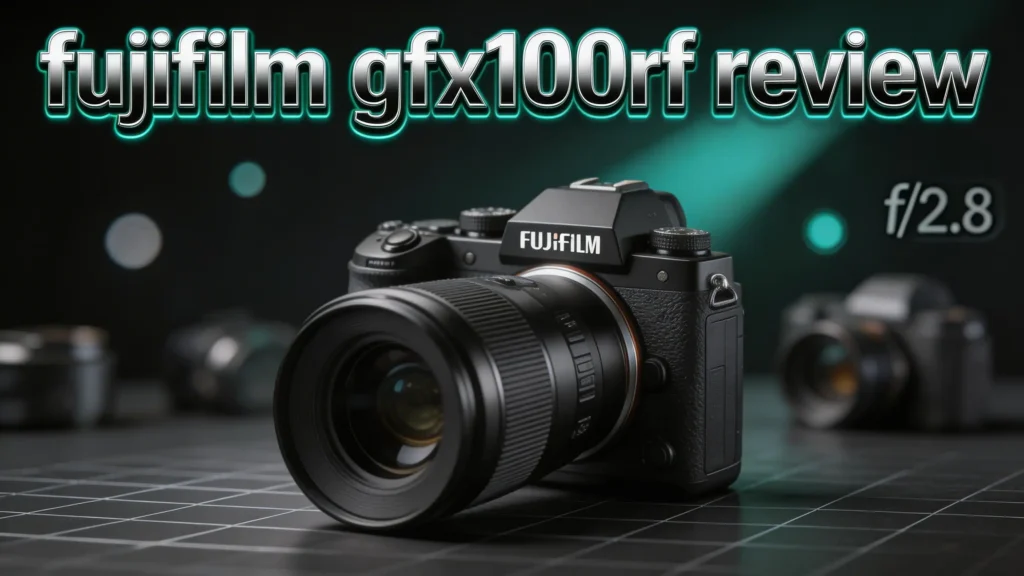
This camera is special. It packs a massive 44x33mm sensor, a sharp fixed 35mm lens, and a gorgeous rangefinder body into a package that weighs just 735 grams.
The GFX100RF recently won the prestigious iF Design Award for its brilliant engineering and design. But does it live up to the hype? Is it worth the $4,899 price tag?
In this detailed Fujifilm GFX100RF review for 2026, we break down every feature, every strength, and every weakness.
Key Takeaways
- The Fujifilm GFX100RF is the smallest and lightest digital medium format camera ever made. It weighs just 735 grams with battery and card included. You can carry it all day without fatigue and even fit it into a large jacket pocket.
- The 102-megapixel GFX CMOS II sensor delivers exceptional image quality. It is the same sensor found in the GFX100S II. You get 16-bit RAW files, a base ISO of 80, and all 20 Fujifilm Film Simulation modes for stunning color and detail.
- The fixed FUJINON 35mm f/4 lens is extremely sharp from edge to edge. It equals a 28mm field of view in full frame terms. The digital teleconverter lets you crop to 35mm, 50mm, or 63mm equivalents while keeping usable resolution.
- There is no in-body image stabilization (IBIS). This is the biggest trade off Fujifilm made to keep the body small. Street and daytime shooters will barely notice. Landscape shooters may want a tripod for slower shutter speeds.
- The unique Aspect Ratio Dial is a standout feature. It lets you switch between 4:3, 3:2, 1:1, 16:9, 65:24, and more with a simple click. The panoramic 65:24 mode recreates the classic Hasselblad X-Pan look.
- At $4,899, the GFX100RF costs less than the Leica Q3 while offering a larger sensor and more megapixels. It competes directly with premium compact cameras and gives medium format shooters a truly portable option.
Fujifilm GFX100RF Overview and First Impressions

- Compact, portable rangefinder style design delivers classic camera handling
- New Aspect Ratio dial for instant access to a variety of compositional image formats
Last update on 2026-09-26 / Affiliate links / Images from Amazon Product Advertising API
The Fujifilm GFX100RF is a fixed lens, rangefinder style medium format camera. It launched in April 2025 and has since become one of the most talked about cameras in the photography community. Fujifilm built it as a spiritual successor to the wildly popular X100 series, but with a much larger sensor.
The first thing you notice is the build quality. The top and bottom plates are fully machined aluminum. The body feels solid, premium, and refined. Every dial clicks with precision. Every surface has the right amount of texture.
Fujifilm included a weather sealed design when paired with the included filter adapter and protective filter. This means you can shoot in light rain or dusty conditions with confidence. The camera also ships with a metal lens cap, a square lens hood, and a rope style shoulder strap.
The overall experience screams quality. This camera does not feel like a compromise. It feels like a statement from Fujifilm about what medium format photography can be.
Design and Build Quality of the GFX100RF
The GFX100RF borrows heavily from the Fujifilm X100 design language. The rangefinder profile is slim and elegant. It sits comfortably in one hand. The grip is small but effective enough for casual shooting.
The camera measures just slightly taller than an X100VI. That is remarkable for a medium format body. The weight of 735 grams puts it in the same territory as many full frame mirrorless cameras. You almost forget you are carrying a medium format sensor.
All the dials are knurled and machined with care. The shutter speed dial, exposure compensation dial, and aperture ring all feel satisfying to use. Fujifilm added a new front command dial placed between the on/off lever and a zoom toggle switch.
The back of the camera features a tilting 3.2 inch touchscreen with 2.1 million dots. It does not flip out fully, but it tilts enough for low and high angle shots. The 5.76 million dot EVF is bright, detailed, and accurate.
Top 3 Alternatives for Fujifilm GFX100RF

- Leica Q3: A groundbreaking digital camera renowned for its innovative features and...
- Triple Resolution Sensor: Featuring a first-ever 60MP BSI CMOS sensor with Triple...
Last update on 2026-09-26 / Affiliate links / Images from Amazon Product Advertising API

- 40.2MP X-Trans CMOS 5 HR Sensor
- Up to 6.0 stops In-Body Image Stabilization
Last update on 2026-09-26 / Affiliate links / Images from Amazon Product Advertising API

- FUJIFILM GFX100S II digital camera features a newly developed sensor and processor...
- Small, light, ergonomic body weighing 883g1 (1.95lbs) that is comparable in weight and...
Last update on 2026-09-26 / Affiliate links / Images from Amazon Product Advertising API
The 102MP Sensor: Image Quality Breakdown
The GFX100RF uses the same GFX 102MP CMOS II sensor found in the GFX100S II. This is a 44x33mm backside illuminated chip processed by the X-Processor 5. The results are extraordinary.
Files from this sensor contain an incredible amount of detail. You can crop aggressively and still produce print worthy images. The base ISO of 80 provides excellent dynamic range. RAW files in 16-bit mode give you tremendous flexibility in post production.
High ISO performance is also impressive for a medium format sensor. Images at ISO 3200 remain clean and usable. Even ISO 6400 produces acceptable results for many situations. The large pixel pitch of the sensor helps keep noise under control.
Color science is classic Fujifilm. All 20 Film Simulation modes are available. Velvia delivers punchy landscapes. Classic Negative adds vintage character. Acros produces beautiful black and white images. The JPEG output is so good that many shooters skip RAW editing entirely.
The FUJINON 35mm f/4 Fixed Lens
The GFX100RF features a brand new FUJINON 35mm f/4 lens built into the body. In full frame terms, this equals a 28mm field of view. That makes it a natural choice for street, travel, architecture, and landscape photography.
Sharpness is outstanding. The center of the frame is razor sharp at f/4. Corner sharpness is equally impressive. You do not need to stop down to improve image quality. Flat surfaces like building facades and landscapes look excellent across the entire frame.
The lens resists flare and ghosting very well. Even with the sun in the frame, contrast stays high. Chromatic aberration is minimal. Distortion is well controlled for a wide angle lens.
The main compromise is the f/4 maximum aperture. This limits depth of field control. Bokeh is present but not creamy. Backgrounds can look slightly busy with a soap bubble effect in highlights. If you want dreamy separation, the Leica Q3 with its f/1.7 lens has a clear advantage here.
Digital Teleconverter and Aspect Ratio Dial
Two features make the GFX100RF more versatile than its single focal length suggests. The first is the digital teleconverter. A toggle switch on the front of the camera lets you crop to 35mm, 50mm, or 63mm full frame equivalent fields of view.
With 102 megapixels to work with, these crops still produce highly usable images. The 50mm equivalent crop gives you roughly 40 megapixels. That is more than enough for large prints. This feature turns a single lens camera into a multi focal length tool.
The second standout feature is the Aspect Ratio Dial on the back. This dedicated dial lets you switch between ratios like 4:3, 3:2, 1:1, 16:9, and the cinematic 65:24. The panoramic 65:24 mode recreates the legendary Hasselblad X-Pan look. It became an instant favorite among creators.
You can choose to display frame lines, a hard crop, or a dimmed area outside the crop in the viewfinder. This helps you compose with intention and see exactly what your final image will look like.
Autofocus Performance in 2026
The GFX100RF uses the same autofocus system as the rest of the current GFX lineup. Single point AF is fast and accurate. It locks onto subjects with confidence in good light. Face and eye detection also perform reliably for portraits and casual shooting.
Subject detection modes handle slow moving subjects well. The camera can recognize faces, eyes, and animals with reasonable accuracy. For street photography and travel shooting, the AF system works without issue most of the time.
The weak spot is continuous tracking. Fast moving subjects can confuse the system. The camera sometimes loses lock during quick action. This is not a sports or wildlife camera, and the AF confirms that.
Low light autofocus is another area that can struggle. In dimly lit streets or indoor settings, the camera may hunt before finding focus. Single point AF with manual adjustment remains the most reliable approach in these conditions. Fujifilm has room to improve AF performance through firmware updates.
No IBIS: How Big of a Deal Is It?
The lack of in-body image stabilization is the most debated aspect of the GFX100RF. Fujifilm removed IBIS to keep the body small and light. This decision has real consequences for certain photographers.
For street and travel photography, the impact is minimal. You typically shoot at shutter speeds of 1/125 or faster in daylight. The camera’s leaf shutter helps reduce vibration. Most handheld shots at 1/60 or faster come out sharp.
For landscape and architecture photography, the absence of IBIS means you will need a tripod for slower shutter speeds. A 102-megapixel sensor amplifies even the smallest hand movement. Shooting handheld below 1/30 is risky without stabilization.
Video shooters feel the impact the most. Handheld footage shows noticeable jitter. The digital stabilization option crops the image and can produce artifacts. A gimbal or tripod is strongly recommended for video work. The built in 4-stop ND filter helps with exposure, but it cannot fix shaky hands.
Video Capabilities of the GFX100RF
The GFX100RF captures 4K video at up to 30 frames per second in 4:2:2 10-bit quality. It uses pixel binning to downsample the 102MP sensor. This reduces moire but also slightly softens the image compared to a native 4K readout.
Fujifilm included F-Log and F-Log2 recording for color grading flexibility. The Eterna Film Simulation mode provides a cinematic look straight out of camera. Base ISO of 100 in video mode keeps noise low.
The camera has dedicated microphone and headphone jacks built into the body. This is a notable advantage over the Fujifilm X100VI and the Leica Q3. You do not need adapters or dongles. Professional monitoring tools like waveforms, vectorscopes, and RGB parade are also available.
The 4-stop ND filter is useful for outdoor video where you want to maintain a cinematic shutter speed. However, the lack of IBIS and any form of effective digital stabilization makes handheld video a challenge. This camera works best for video on a tripod or gimbal.
Battery Life and Storage
Battery life on the GFX100RF is surprisingly excellent. The camera uses the Fujifilm NP-W235 battery. It delivers approximately 820 shots per charge based on CIPA ratings. That is enough for a full day of shooting without carrying a spare.
The absence of IBIS likely contributes to this strong battery performance. The stabilization motor in other cameras draws significant power. Without it, the GFX100RF can dedicate more energy to the sensor and processor.
The camera features twin UHS-II SD card slots. This is a welcome inclusion at this price point. You can use one slot for overflow storage. Or you can set up redundant recording to back up every shot to both cards simultaneously.
Fast SD cards are recommended because the 102MP files are large. A single uncompressed 16-bit RAW file can exceed 200MB. Quick write speeds prevent buffer delays during burst shooting. The camera supports up to 40 consecutive RAW frames at 6 frames per second.
Fujifilm GFX100RF vs Leica Q3

- Compact, portable rangefinder style design delivers classic camera handling
- New Aspect Ratio dial for instant access to a variety of compositional image formats

Last update on 2026-09-26 / Affiliate links / Images from Amazon Product Advertising API
The Leica Q3 is the most obvious competitor to the GFX100RF. Both are premium fixed lens compact cameras. Both target photographers who value image quality and portability. The differences, however, are significant.
The GFX100RF has a larger 44x33mm sensor with 102 megapixels. The Leica Q3 uses a 60MP full frame sensor. The Fujifilm delivers more detail and more room to crop. The larger sensor also produces a slightly different rendering with more tonal depth.
The Leica Q3 fights back with a 28mm f/1.7 Summilux lens. That is nearly three stops faster than the GFX100RF’s f/4 lens. The Leica offers better low light performance and much shallower depth of field. It also includes IBIS, which the Fujifilm lacks.
Price is where the GFX100RF wins clearly. At $4,899, it costs less than the Leica Q3’s roughly $5,995 asking price. You get a bigger sensor and more megapixels for less money. The choice comes down to what matters more to you: the speed and stabilization of the Leica, or the sheer resolution and value of the Fujifilm.
Film Simulations and Color Science
Fujifilm’s Film Simulation modes are a major draw for the GFX100RF. All 20 profiles are available. This includes the newest REALA ACE mode and the beloved Classic Negative, Velvia, and Acros profiles.
Each Film Simulation changes the color, contrast, and tone of your images. Velvia boosts saturation for vivid landscapes. Classic Chrome delivers muted, documentary style tones. PRO Neg. Hi offers rich contrast for portraits. The variety lets you shoot JPEG with confidence.
The REALA ACE simulation deserves special attention. It provides faithful color reproduction with a slightly harder tonality. It works across all subjects and lighting conditions. Many photographers have adopted it as their default profile.
For black and white shooters, Acros remains the gold standard. It produces deep blacks, smooth gradients, and beautiful grain simulation. You can apply color filters like red, yellow, or green to change how tones translate. The monochrome output from this sensor is truly stunning.
Who Should Buy the Fujifilm GFX100RF?
The GFX100RF is perfect for street photographers who want medium format quality in a portable body. It suits travel shooters who refuse to compromise on image quality. Landscape photographers will love the resolution, detail, and dynamic range.
Fine art photographers will appreciate the ability to make massive prints from 102-megapixel files. The edge to edge sharpness of the lens and the tonal richness of the sensor produce gallery worthy results. The aspect ratio dial adds creative flexibility right at the point of capture.
This camera is not ideal for action, sports, or wildlife photographers. The autofocus tracking is limited. The fixed 28mm equivalent focal length is too wide for distant subjects. The lack of IBIS makes telephoto cropping less reliable at slower shutter speeds.
If you already own a Fujifilm X100VI and want to step up, the GFX100RF is a natural upgrade. It provides a similar shooting experience with a dramatically better sensor. The price jump is significant, but the image quality difference is immediately visible.
Pros and Cons of the Fujifilm GFX100RF
Pros: The GFX100RF delivers 102 megapixels of medium format resolution in a body smaller than most full frame cameras. The build quality is superb. The fixed lens is extremely sharp. Film Simulations are beautiful. Battery life is excellent. The aspect ratio dial adds genuine creative value. The price undercuts the Leica Q3 by over $1,000.
The camera also feels fun to use. The retro dials, the tactile controls, and the compact size create an engaging shooting experience. You want to pick it up and go out to shoot. That emotional connection matters.
Cons: The f/4 aperture limits low light performance and depth of field control. The lack of IBIS hurts video shooters and anyone working at slow shutter speeds. Continuous autofocus tracking falls behind competitors like Sony and Canon. The bokeh rendering can look harsh in certain backgrounds.
The fixed 28mm equivalent focal length is a limitation for some genres. You rely on cropping for tighter compositions. While the 102 megapixels give you room, it is not the same as having a dedicated longer lens.
Final Verdict: Is the Fujifilm GFX100RF Worth It in 2026?
The Fujifilm GFX100RF is one of the most exciting cameras released in recent years. It proves that medium format photography does not require a heavy, bulky body. It brings 102 megapixels, rich color science, and an exceptional lens into a package you can carry all day.
The trade offs are real. No IBIS, a modest f/4 aperture, and limited AF tracking mean this camera does not try to do everything. But what it does, it does brilliantly. Street, travel, architecture, landscape, and fine art photographers will find a deeply rewarding tool here.
At $4,899, it offers more sensor and more resolution than the Leica Q3 for less money. It provides a shooting experience that rivals the X100VI in joy and simplicity. If you value image quality above all else and the 28mm equivalent focal length suits your vision, the GFX100RF is easy to recommend. This camera earns its place as one of the best compact cameras of 2026.
Frequently Asked Questions
Is the Fujifilm GFX100RF a full frame camera?
No. The GFX100RF uses a 44x33mm medium format sensor, which is larger than full frame. The sensor area is about 1.7 times bigger than a standard 36x24mm full frame sensor. This gives it more detail, better dynamic range, and richer tonal quality. The fixed 35mm lens provides a 28mm equivalent field of view in full frame terms.
Does the Fujifilm GFX100RF have image stabilization?
The GFX100RF does not have in-body image stabilization (IBIS). Fujifilm removed it to keep the camera as small and light as possible. There is a digital image stabilization option for video, but it applies a heavy crop and can introduce artifacts. For sharp handheld stills, you should aim for shutter speeds of 1/60 or faster.
How much does the Fujifilm GFX100RF cost?
The Fujifilm GFX100RF has a manufacturer suggested retail price of $4,899.95 USD. It is available in both black and silver finishes. The price includes the built in 35mm f/4 lens, filter adapter, protective filter, lens hood, and a shoulder strap in the box.
Can the Fujifilm GFX100RF shoot video?
Yes. The GFX100RF records 4K video at 30 frames per second in 4:2:2 10-bit quality. It supports F-Log and F-Log2 for color grading. It has built in microphone and headphone jacks. However, the lack of IBIS means handheld video will show noticeable shake. A tripod or gimbal is recommended for best results.
What is the Aspect Ratio Dial on the GFX100RF?
The Aspect Ratio Dial is a dedicated physical dial on the back of the camera. It lets you switch between different image aspect ratios instantly. Options include 4:3, 3:2, 1:1, 16:9, 65:24, and more. The 65:24 panoramic mode mimics the classic Hasselblad X-Pan film camera look. The selected ratio applies to JPEG output, while the full sensor RAW file is always preserved.
Is the Fujifilm GFX100RF better than the Leica Q3?
It depends on your priorities. The GFX100RF offers a bigger sensor (44x33mm vs full frame) and more megapixels (102 vs 60) at a lower price. The Leica Q3 has a faster f/1.7 lens, IBIS, and 8K video capability. The Fujifilm wins on resolution and value. The Leica wins on low light performance, stabilization, and depth of field control. Both are excellent cameras for different reasons.

I’m Lipi, a passionate blogger with a keen interest in artificial intelligence and its applications. On my blog, lipiai.blog, I share information about AI, review different AI tools, and provide helpful guides. My goal is to make AI easy to understand for everyone. I enjoy simplifying complex ideas so that both beginners and tech-savvy folks can learn.