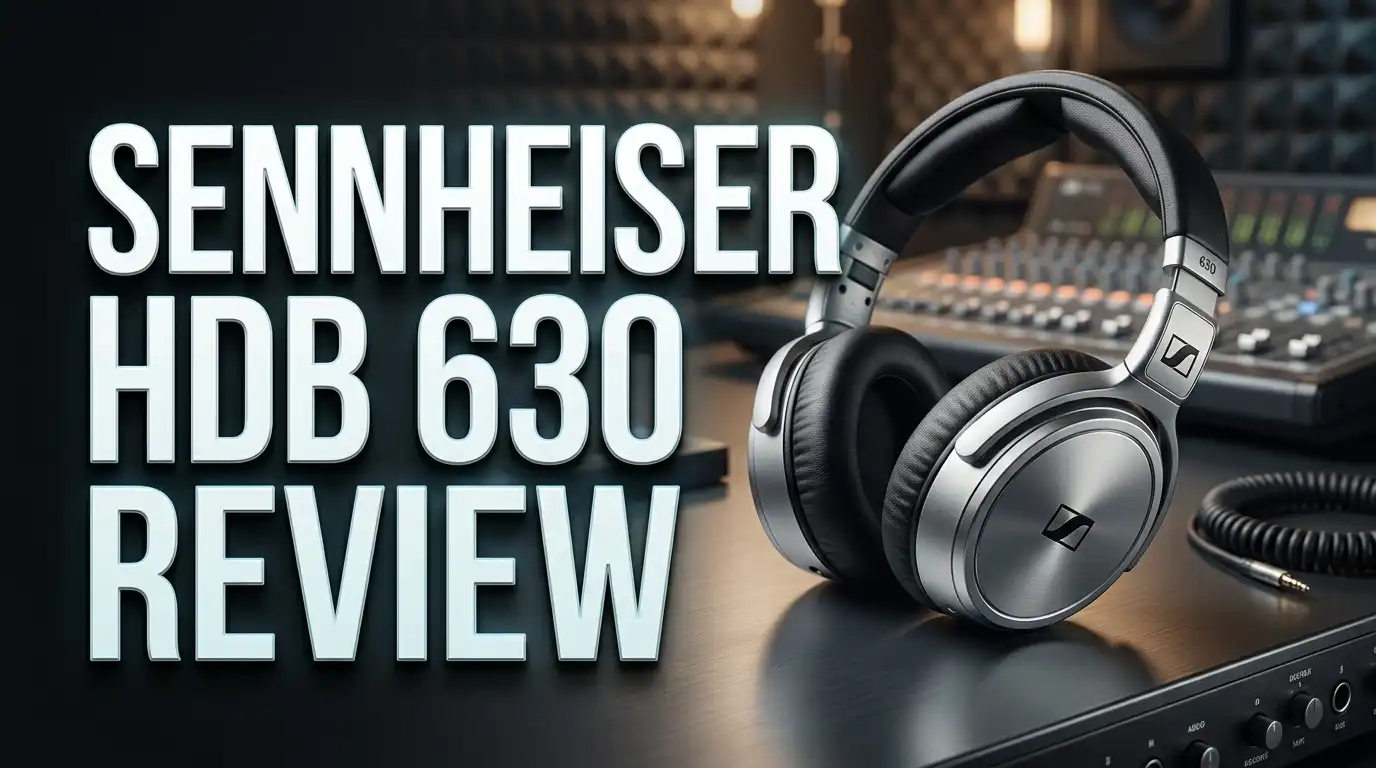
Sennheiser HDB 630 Review 2026: Is This the Best?
Are you hunting for a wireless headphone that sounds like a wired audiophile set? The Sennheiser HDB 630 might be exactly what you need. This closed-back, over-ear wireless headphone launched in late 2025 and shook up the premium Bluetooth market.
Sennheiser priced the HDB 630 at $499.95. That puts it right between the popular Momentum 4 and high-end competitors like the Focal Bathys.
But does it live up to the hype? This review covers everything from sound quality and comfort to noise cancellation and app features.
Key Takeaways
- The Sennheiser HDB 630 delivers a neutral, reference-grade sound that pulls inspiration from the legendary Sennheiser HD 560. It prioritizes clarity, detail, and accurate imaging over heavy bass or artificial warmth. This is a headphone for listeners who want to hear music as it was recorded.
- Battery life is class-leading at 60 hours on a single charge. Even with the included BTD 700 Bluetooth dongle active, you still get around 45 hours. A quick 10-minute charge gives you 7 hours of playback. You can go days without plugging in.
- The parametric EQ and crossfeed features set it apart from competitors. The Sennheiser Smart Control Plus app gives you surgical control over specific frequencies, bandwidth, and filter types. The crossfeed feature blends left and right channels for a more speaker-like experience, which is great for classical and older recordings.
- Active noise cancellation is strong and adaptive. It blocks out office chatter, airplane cabin noise, and general background hum without making your ears feel pressured. It does not match Sony’s best ANC, but it comes very close.
- Build quality is premium and travel-friendly. The headphone folds flat, weighs only 311 grams, and ships with a hard-shell case, an in-flight adapter, a USB-C cable, a 3.5mm cable, and the BTD 700 dongle. The Japanese protein leatherette earpads feel soft and breathable.
- At $499.95, the HDB 630 offers serious value for audiophile-grade wireless sound. It outperforms the Momentum 4 in detail and soundstage. It competes directly with headphones like the Focal Bathys and Bowers & Wilkins Px8 S2.
Sennheiser HDB 630 Overview and First Impressions

- Audiophile tuning: Sennheiser’s in-house 42 mm transducer and refined acoustic design...
- Wireless or wired: Enjoy high-resolution wireless sound with support for aptX HD and aptX...
Last update on 2026-11-09 / Affiliate links / Images from Amazon Product Advertising API
The Sennheiser HDB 630 arrived in a clean, well-organized box. Inside, you get the headphones, a hard-shell carrying case, a BTD 700 Bluetooth USB-C dongle, a 1.2m USB-C audio and charging cable, a 1.2m audio cable with a 3.5mm plug, and an in-flight adapter. The package feels complete and premium right from the start.
My first impression was positive. The HDB 630 feels solid but light in the hand. The matte black finish resists fingerprints well. The earcups fold flat for storage, and the carrying case holds everything snugly.
I paired the headphone with my phone over Bluetooth 5.2 in seconds. The first track I played showed off the wide soundstage and detailed midrange. This headphone is clearly tuned for accuracy and clarity, not bass-heavy fun. It felt like a step up from my Momentum 4 from the very first listen.
Design and Build Quality
The Sennheiser HDB 630 shares its chassis with the Sennheiser Momentum 4. However, Sennheiser made several smart improvements. The headband uses a leatherette material instead of fabric. The earcups have a slightly bulkier housing, but this does not add extra weight.
The matte black finish looks professional and clean. Silver accents on the earcups and headband break up the dark look and add a premium touch. The yokes are sturdy and well-engineered. They adjust smoothly and hold their position without slipping.
The earpads use Japanese protein leatherette. This material feels soft, breathable, and durable. It keeps your ears cool during long listening sessions. The headband padding matches the earpads in material and comfort. The overall weight sits at just 311 grams, which makes the HDB 630 one of the lighter wireless headphones in this price range.
Comfort and Fit for All-Day Wear
Comfort is a top priority for any headphone you plan to use for hours. The Sennheiser HDB 630 delivers here. The over-ear design creates a full seal around each ear without excessive clamping force.
I wore the HDB 630 for multiple 4 to 6-hour sessions. My ears stayed cool and dry. I did not feel any pressure points on the top of my head or around my ears. The earpads are deep enough to avoid touching the ears directly.
The headband distributes weight evenly across the top of the head. This prevents the “hot spot” problem that many heavy headphones cause. For glasses wearers, the earpads have enough give to form a seal even with temple arms in the way.
If you work from home or travel often, the HDB 630 is a strong choice for extended wear. It folds flat for travel and fits neatly into its included hard-shell case.
Top 3 Alternatives for Sennheiser HDB 630
No products found.

- PREMIUM NOISE CANCELLATION: Two processors control 8 microphones for unprecedented noise...
- MAGNIFICENT SOUND: Engineered to perfection with the new Integrated Processor V1.
Last update on 2026-11-09 / Affiliate links / Images from Amazon Product Advertising API
No products found.
Sound Quality: Bass Performance
The Sennheiser HDB 630 takes a different approach to bass. It does not boost the low end like the Momentum 4 or Sony XM5. Instead, it delivers fast, controlled, and accurate bass that supports the rest of the frequency range.
The sub-bass extends deep. You can hear and feel it in EDM, hip-hop, and electronic tracks. However, it does not thump or rumble in a way that overpowers the mix. The mid-bass is the real star here. It sounds full-bodied and punchy without bleeding into the midrange.
If you are a bass lover, you might initially feel that the HDB 630 is lacking. But give it time. The clean, tight bass lets you hear details in tracks that heavier bass headphones often mask. The parametric EQ in the app also lets you boost specific bass frequencies if you want more low-end energy. This is clean, reference-grade bass at its best.
Sound Quality: Midrange and Treble
The midrange is where the Sennheiser HDB 630 truly shines. Vocals sound natural, present, and lifelike. Instruments carry accurate timbre and texture. You hear the rasp in a singer’s voice and the resonance of an acoustic guitar with stunning clarity.
The upper midrange reveals fine details without harshness. This makes the HDB 630 a perfect choice for vocal-heavy genres like acoustic, indie, folk, rock, and country. Classical music also benefits from the accurate instrument separation and wide soundstage.
The treble stays refined and controlled. It adds air and sparkle without crossing into sibilance or fatigue. High hats, cymbals, and string overtones ring out naturally. Sennheiser tuned the treble to balance the bass perfectly, so the overall signature feels even and cohesive.
This is a headphone that rewards critical listening. The more attention you pay, the more details you discover in your music.
Soundstage and Imaging
Closed-back headphones often struggle with soundstage. The Sennheiser HDB 630 breaks that pattern. It creates a wide and deep sound field that feels open and spacious.
Instrument placement is accurate and precise. In orchestral recordings, you can pinpoint where each section sits in the stereo image. The depth is noticeably greater than the Momentum 4, and it rivals open-back headphones in how it presents space.
Separation between instruments is excellent. Individual elements sound distinct and clearly defined. Nothing fights for attention in the mix. This makes the HDB 630 a great pick for complex, layered recordings like jazz, classical, and progressive rock.
The crossfeed feature in the Sennheiser app adds another layer of control. It blends the left and right channels slightly to mimic a two-speaker setup in a room. This works well for older recordings with hard-panned instruments.
Active Noise Cancellation Performance
The Sennheiser HDB 630 features adaptive active noise cancellation (ANC). It uses integrated microphones to detect and block ambient sound. The ANC works well in offices, airplanes, trains, and busy cafes.
In my testing, the ANC blocked out office chatter, HVAC noise, and general background hum with ease. Phone calls happening nearby became inaudible with music playing. The ANC does not create the uncomfortable pressure feeling that some competitors produce.
Compared to Sony’s ANC, the HDB 630 falls slightly short. Sony still leads in raw noise cancellation strength. However, the Sennheiser ANC does not degrade sound quality, which is a major advantage. Many ANC headphones sacrifice audio clarity for silence. The HDB 630 keeps both.
You get three modes: full ANC, transparency mode, and ANC off. The adaptive mode adjusts automatically based on your environment. You can also fine-tune these settings in the Smart Control Plus app.
Battery Life and Charging
Battery life is one of the HDB 630’s strongest features. Sennheiser rates it at up to 60 hours of playback on a single charge with ANC active. That is enough to last most people an entire work week without charging.
When using the BTD 700 Bluetooth dongle for hi-res streaming, battery life drops to around 45 hours. This is still excellent. A full charge takes about two hours through the USB-C port.
The fast charging feature is a lifesaver. Just 10 minutes of charging gives you 7 hours of playback. If you forget to charge overnight, a quick morning top-up covers your entire day. The USB-C cable doubles as both a charging cable and a wired audio connection, so you always have a backup option if the battery runs out.
Bluetooth Connectivity and Codec Support
The Sennheiser HDB 630 supports Bluetooth 5.2 with a strong selection of codecs. It works with SBC, AAC, aptX, aptX HD, and aptX Adaptive. The aptX Adaptive codec supports up to 24-bit/96kHz streaming for high-resolution audio.
The included BTD 700 Bluetooth USB-C dongle is a standout accessory. It upgrades any USB-C device into an aptX Adaptive transmitter. This means you get hi-res audio from laptops, gaming consoles, and other devices that might not natively support advanced Bluetooth codecs.
The headphone supports multipoint pairing with up to two devices at once. It can store six paired devices in memory. Switching between devices is quick and reliable. This makes the HDB 630 a good fit for people who juggle between a phone and a laptop throughout the day.
Low-latency performance also makes the HDB 630 suitable for video calls and light gaming. The connection stayed stable during my testing with no noticeable audio delay.
Smart Control Plus App and Parametric EQ
The Sennheiser Smart Control Plus app unlocks the full potential of the HDB 630. This is a different app from Sennheiser’s older Smart Control app, so make sure you download the correct one.
The app gives you access to a parametric equalizer with full control over frequency, gain, bandwidth, and filter type. This level of control is rare in wireless headphones at any price. You can target specific problem frequencies, boost certain ranges, or create entirely custom sound profiles. The visual graph makes it easy to see and adjust your changes in real time.
The crossfeed feature blends the left and right audio channels slightly. This creates a more natural, speaker-like presentation. It works well for classical music and older stereo recordings with hard-panned instruments.
Other app features include ANC adjustment, transparency mode control, battery tracking, firmware updates, and sound zone settings. The app is clean, responsive, and well-organized.
Sennheiser HDB 630 vs Momentum 4
Many buyers will compare the HDB 630 to the Sennheiser Momentum 4 since they share a similar design. The key difference is in sound tuning. The Momentum 4 has a warmer, bass-forward signature. The HDB 630 delivers a more neutral, reference-grade sound with better detail retrieval.
The HDB 630 has a wider and deeper soundstage. Instruments have more room to breathe, and imaging is more accurate. The Momentum 4 sounds more forward and intimate by comparison.
Both headphones offer 60-hour battery life and Bluetooth 5.2. The HDB 630 adds the BTD 700 dongle, parametric EQ, and crossfeed features that the Momentum 4 does not have. The HDB 630 also uses upgraded leatherette materials on the headband.
The Momentum 4 costs less and remains a strong option for listeners who prefer a fun, warm sound. But if you value accuracy, detail, and customization, the HDB 630 is the clear upgrade.
Who Should Buy the Sennheiser HDB 630?
The Sennheiser HDB 630 is best for audiophiles who want wireless freedom without sacrificing sound quality. If you listen to vocal-heavy music, acoustic, classical, rock, or jazz, this headphone delivers exceptional performance.
It is also a strong choice for remote workers and frequent travelers. The 60-hour battery life, comfortable fit, and effective ANC make it ideal for long flights and all-day work sessions. The BTD 700 dongle adds flexibility for connecting to gaming setups and laptops.
If you primarily listen to bass-heavy EDM, trap, or hip-hop and want maximum low-end impact out of the box, you might prefer the Momentum 4 or Sony WH-1000XM5 instead. The HDB 630’s bass is accurate and present, but it does not slam as hard as consumer-tuned headphones.
Budget-conscious buyers should also consider whether the $499.95 price fits their needs. The Momentum 4 offers similar comfort and battery life at a lower price, even if it lacks the HDB 630’s advanced features.
Final Verdict: Is the Sennheiser HDB 630 Worth It in 2026?

- Audiophile tuning: Sennheiser’s in-house 42 mm transducer and refined acoustic design...
- Wireless or wired: Enjoy high-resolution wireless sound with support for aptX HD and aptX...
Last update on 2026-11-09 / Affiliate links / Images from Amazon Product Advertising API
The Sennheiser HDB 630 earns a strong recommendation. It delivers audiophile-grade sound quality in a wireless, closed-back form factor. The neutral tuning, wide soundstage, and excellent detail retrieval set it apart from competitors like the Sony WH-1000XM5 and Momentum 4.
The feature set is outstanding for the price. You get a parametric EQ, crossfeed, adaptive ANC, 60-hour battery life, hi-res Bluetooth codec support, and the BTD 700 dongle all for $499.95. Few wireless headphones at this price offer this level of control and performance.
Build quality and comfort are excellent. The HDB 630 feels premium, folds flat for travel, and stays comfortable for hours. If you want the best wireless headphone for critical listening in 2026, the Sennheiser HDB 630 should be at the top of your list.
Frequently Asked Questions
Is the Sennheiser HDB 630 good for gaming?
The HDB 630 works well for casual gaming. The low-latency Bluetooth connection and BTD 700 USB-C dongle reduce audio delay. The wide soundstage helps with positional audio in games. However, it is not a dedicated gaming headset and lacks features like a boom microphone. For competitive gaming, a wired gaming headset may serve you better.
Does the Sennheiser HDB 630 support lossless audio?
The HDB 630 does not support aptX Lossless over Bluetooth. However, it supports aptX Adaptive at up to 24-bit/96kHz, which delivers near-lossless quality. For true lossless playback, you can use the USB-C wired connection or the 3.5mm audio cable, both of which bypass Bluetooth compression entirely.
How does the Sennheiser HDB 630 compare to the Focal Bathys?
Both headphones target audiophile wireless listeners at a similar price point. The HDB 630 offers longer battery life (60 hours vs. 30 hours), a lighter weight, and the included BTD 700 dongle. The Focal Bathys delivers a slightly different sound signature with its aluminum-magnesium drivers. Your choice depends on whether you prefer Sennheiser’s neutral tuning or Focal’s detailed, articulate presentation.
Can you use the Sennheiser HDB 630 wired?
Yes. The HDB 630 includes both a 3.5mm audio cable and a USB-C audio cable. The USB-C cable supports up to 24-bit/96kHz playback. You can listen in wired mode even when the battery is dead using the 3.5mm cable, though sound quality is best in active mode.
Is the Sennheiser HDB 630 comfortable for glasses wearers?
The Japanese protein leatherette earpads are soft and have enough give to seal around glasses temple arms. Most glasses wearers report a comfortable fit. However, as with any over-ear headphone, very thick or wide temple arms may slightly affect the seal and comfort during extended sessions.

I’m Lipi, a passionate blogger with a keen interest in artificial intelligence and its applications. On my blog, lipiai.blog, I share information about AI, review different AI tools, and provide helpful guides. My goal is to make AI easy to understand for everyone. I enjoy simplifying complex ideas so that both beginners and tech-savvy folks can learn.