
Fujifilm X-T30 III Review 2026: Best Budget Mirrorless Camera?
The Fujifilm X-T30 III landed in late 2025, and it quickly became Amazon’s #1 best-selling mirrorless camera. That alone tells you something. But does it actually deserve all the hype?
This compact, retro-styled shooter packs a new processor, AI-powered autofocus, a dedicated Film Simulation dial, and 6.2K video into a body that weighs just 378 grams. It costs $999 for the body and $1,150 with the new XC 13-33mm kit lens.
In this review, we break down everything you need to know about its image quality, autofocus performance, video capabilities, build quality, and more. Read on to find out if this little Fujifilm is right for you.
Key Takeaways
- The Fujifilm X-T30 III uses a proven 26.1MP X-Trans CMOS 4 sensor paired with the newer X-Processor 5. This combination delivers excellent image quality with vibrant, crowd-pleasing Fujifilm colors straight out of the camera.
- AI-powered subject detection autofocus can recognize humans, animals, birds, cars, motorcycles, airplanes, and trains. It handles everyday photography well, though it falls slightly behind Nikon and Canon rivals for fast action tracking.
- The new Film Simulation dial replaces the old drive mode dial. It gives instant access to 20 Film Simulations and three custom “recipe” positions. This is a standout feature that makes creative shooting fast and fun.
- Video specs are impressive for the price point. The camera records 6.2K at 30fps from the full sensor, 4K at 60fps with a minor 1.18x crop, and 1080p at up to 240fps for slow motion.
- There is no in-body image stabilization and no weather sealing. These are the biggest trade-offs at this price. If you need stabilization, the Fujifilm X-S20 is a better pick.
- The compact body is both a blessing and a challenge. It is easy to carry everywhere, but the many buttons and dials on a small frame can feel cramped, especially for beginners or people with larger hands.
Fujifilm X-T30 III Overview and First Impressions

- Built for ease of use with Auto mode to keep you in the moment
- Dial in your style with endless creativity powered by 20 built in Film Simulations
Last update on 2026-11-11 / Affiliate links / Images from Amazon Product Advertising API
The Fujifilm X-T30 III is a compact APS-C mirrorless camera that carries forward the classic SLR-shaped design of the X-T line. It launched in late November 2025 at a retail price of $999 body only. A kit with the new XC 13-33mm F3.5-6.3 OIS lens costs around $1,150.
First impressions are strong. The camera looks and feels premium despite its entry-level positioning. The tactile rubber grip on the front and rear gives you a secure hold. You get a 2.36 million-dot electronic viewfinder, a tilting 3-inch touchscreen, and a built-in pop-up flash.
Fujifilm positions this as a gateway camera. It is meant for smartphone users stepping up to a real camera, and for photo enthusiasts who want Fujifilm colors without a high price tag. The AUTO mode switch lever on the top plate makes it easy to jump into fully automatic shooting at any time. This is a thoughtful touch for beginners who are still learning exposure settings.
It arrives in three color options: Black, Silver, and Charcoal Silver. All three look great and match the retro aesthetic Fujifilm is known for.
Design and Build Quality
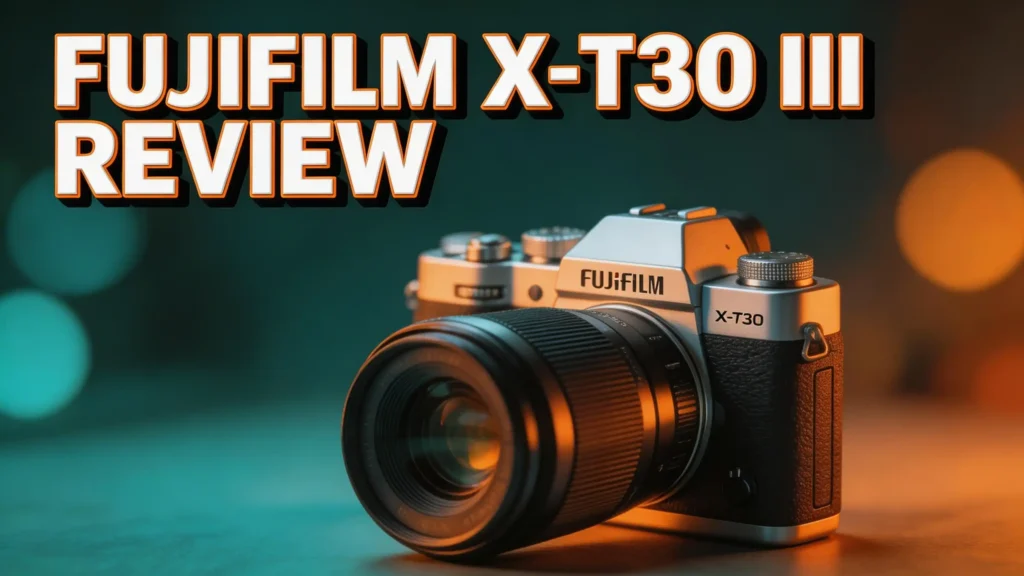
The X-T30 III body is essentially the same physical shell as the X-T30 II. It measures 118 x 83 x 47mm and weighs only 378 grams with the battery and memory card. That makes it the lightest SLR-style mirrorless camera in its price class.
Build materials are a mix of magnesium alloy and polycarbonate. The camera feels solid in the hand. However, it does not have any weather sealing. You need to be careful in rain or dusty conditions.
The top plate is busy with controls. You get a shutter speed dial, an exposure compensation dial, the new Film Simulation dial, and two clickable command dials. There is also an AF joystick on the back, which is extremely useful for moving your focus point quickly.
One issue many reviewers mention is that the controls feel slightly cramped on a body this small. The clickable button under the front command dial is easy to press by accident. This can confuse beginners who do not yet know what each control does. With some time and customization, you can make the layout work for you.
The New Film Simulation Dial
This is the headline feature of the X-T30 III. Fujifilm replaced the old drive mode dial with a dedicated Film Simulation dial. It gives you instant access to the camera’s 20 built-in Film Simulations including favorites like Classic Negative, Nostalgic Neg, Velvia, and Eterna.
The dial also has three custom “FS” positions. You can assign these to specific Film Simulations with modified parameters. Fujifilm calls these “recipes.” The Fujifilm community has been sharing and trading recipes for years, and now you can load them onto the dial for one-click access.
This feature was previously available only on the more expensive X-E5 and X-T50. Getting it on a $999 camera is a big deal. It encourages you to experiment with different color looks while you shoot, rather than spending hours in editing software later.
The Film Simulation dial is what separates the X-T30 III from every competitor at this price. No other camera brand offers anything quite like it. Canon and Nikon have creative color modes, but none are as deep, as attractive, or as community-driven as Fujifilm’s system.
Top 3 Alternatives for Fujifilm X-T30 III
If the X-T30 III does not fit your needs perfectly, these three cameras are strong alternatives to consider in 2026.
1. Nikon Z50 II — This is the closest competitor. It offers better autofocus tracking, a fully articulating screen, and dedicated mic and headphone jacks. It has a 20.9MP sensor and shoots 4K/60p video. The ergonomics are better for larger hands. However, the Nikon Z DX lens selection is still smaller than Fujifilm X-mount.

- Go Beyond Your Phone: Capture lifelike colors and incredible details from dawn to dusk...
- Find Your Aesthetic: At the press of the Picture Control button, choose from 31 built-in...

Last update on 2026-11-11 / Affiliate links / Images from Amazon Product Advertising API
2. Canon EOS R10 — Canon’s APS-C entry offers 24.2MP, 15fps mechanical shutter bursts, and excellent Dual Pixel autofocus. It is great for action and sports. The RF-S lens lineup is growing but still limited compared to Fujifilm. Video is solid but lacks the Fujifilm color science appeal.

- HIGH IMAGE QUALITY: Canon’s 24.2 Megapixel (APS-C) CMOS sensor delivers stunning...
- DIGIC X IMAGE PROCESSOR: Powers 4K video capture and reduces noise, so you can...
Last update on 2026-11-11 / Affiliate links / Images from Amazon Product Advertising API
3. Fujifilm X-S20 — If you want the same Fujifilm colors and sensor but need in-body image stabilization, the X-S20 is your pick. It has a fully articulating screen, standard mic and headphone ports, and longer battery life. It costs more at around $1,300 body only, but the IBIS makes a real difference for video and low-light shooting.

- X-S20 offers the perfect blend of power and portability to turn thoughts and ideas into...
- X-S20 combines powerful sensor and processor technologies to deliver a blistering...
Last update on 2026-11-11 / Affiliate links / Images from Amazon Product Advertising API
Image Quality and Sensor Performance
The X-T30 III uses the same 26.1MP X-Trans CMOS 4 back-side illuminated sensor found in several other Fujifilm cameras. This is a proven chip. It delivers very good detail, dynamic range, and color accuracy.
RAW files hold up well in post-processing. You can recover a solid amount of shadow and highlight detail. JPEG output is also strong, especially when paired with Film Simulations. Fujifilm’s color science is a real advantage here. Many photographers love the straight-out-of-camera JPEGs so much that they skip RAW editing entirely.
High ISO performance is respectable. Images stay clean and detailed up to ISO 3200. Noise becomes more visible at ISO 6400 and above, but it remains manageable with careful noise reduction.
One caveat: shutter shock can affect sharpness with the XC 13-33mm kit lens, especially around 1/100 sec shutter speed. The fix is simple. Set the camera to use the electronic first curtain shutter mode. This eliminates the vibration and keeps your images sharp.
Autofocus System
The X-T30 III uses the same AI-powered autofocus system found in other current Fujifilm cameras. It has a 425-point hybrid AF system with phase detection across the frame.
Subject detection works for humans, animals, birds, cars, motorcycles, airplanes, and trains. For everyday shooting, portraits, and casual street photography, the autofocus performs well. It locks on quickly and accurately in good light.
The weak spot is continuous tracking of fast-moving subjects. The tracking box can wander off target, especially with non-recognized objects or erratic movement. Nikon Z50 II and Canon EOS R10 both perform better in this area.
Switching between human detection and other subject types requires a menu change. This is a small annoyance. You need to set up custom buttons or use the Q menu to switch quickly. It is not a deal-breaker, but it does slow you down slightly in mixed-subject situations.
For most beginners and casual photographers, the autofocus is more than good enough. If you plan to shoot sports or fast action regularly, you may want to consider a Nikon or Canon alternative.
Video Capabilities

- Built for ease of use with Auto mode to keep you in the moment
- Dial in your style with endless creativity powered by 20 built in Film Simulations
Last update on 2026-11-11 / Affiliate links / Images from Amazon Product Advertising API
The X-T30 III punches above its weight class in video. It records 6.2K at 30fps using the full sensor width in an open-gate 3:2 format. It also shoots 4K at 60fps with a small 1.18x crop, and 1080p at 240fps for dramatic slow motion.
Video color is excellent. You can use all 20 Film Simulations in video mode, including the cinematic Eterna simulation. The camera also supports F-Log, F-Log2, and HLG recording for maximum flexibility in post-production. Internal recording is 10-bit 4:2:2, which gives you good color grading latitude.
The big limitation is the lack of in-body image stabilization. Handheld video will show shake unless you use a stabilized lens or a gimbal. The digital stabilization option adds a crop and does not fully solve the problem.
Audio options are limited too. The 2.5mm mic jack requires an adapter for standard 3.5mm microphones. Headphone monitoring is only possible through a USB adapter. These are not ideal setups for serious video work.
If video is your primary focus, the Fujifilm X-S20 is a much better choice within the same brand. But for occasional video clips and social media content, the X-T30 III does a solid job.
Battery Life and Charging
Battery life is a genuine strength of the X-T30 III. It uses the NP-W126S battery and is rated for 315 shots per charge in standard mode. In Economy mode, that number jumps to 425 shots.
Real-world usage often exceeds the official rating. Many users report getting 500 to 600 shots on a single charge with moderate use of image review and minimal video recording. That is enough for a full day of casual shooting or a weekend trip.
USB-C charging is supported. You can top up the battery from a power bank, laptop, or any USB-C charger. This is convenient for travel. You do not need to carry a separate wall charger unless you prefer one.
Carrying a spare NP-W126S battery is still a good idea for long shooting days or heavy video use. The battery is small, lightweight, and affordable. It slips easily into any camera bag pocket.
Handling and Ergonomics
The X-T30 III is a joy to carry around. Its small size and light weight mean you can take it anywhere without thinking twice. Paired with the collapsible XC 13-33mm kit lens, the entire package fits in a large jacket pocket.
The front grip ridge and rear thumb rest provide a surprisingly secure hold for such a small camera. The rubber coating adds good texture. You can shoot one-handed in most situations, though two hands are better for stability.
The tilting touchscreen flips up 90 degrees and down 45 degrees. It is useful for low-angle and high-angle shots. However, it does not flip forward for selfies or vlogging. If self-facing video is important to you, the Nikon Z50 II or Fujifilm X-S20 are better options.
Menu navigation is smooth with the combination of touchscreen, joystick, and command dials. Fujifilm’s menu system has improved over the years. It is organized into logical tabs and categories. New users may still feel a learning curve, but the AUTO mode provides a helpful starting point.
Who Should Buy the Fujifilm X-T30 III?
This camera is ideal for several types of users. Beginner photographers will appreciate the AUTO mode, compact size, and beautiful straight-out-of-camera colors. The Film Simulation dial makes it fun to learn about different creative looks without needing editing software.
Travel photographers will love the lightweight body and excellent image quality. Pair it with a compact prime lens like the XF 27mm F2.8, and you have one of the best travel kits available.
Fujifilm fans on a budget who want the latest processor, Film Simulation dial, and recipe support will find great value here. It shares many features with the more expensive X-T50 and X-E5.
Content creators who primarily shoot photos and occasional short videos will find the specs more than adequate. The 6.2K recording and Film Simulations in video mode are strong selling points.
However, if you shoot lots of video, need IBIS, or require fast and reliable autofocus tracking for sports, this may not be the right camera for you.
Fujifilm X-T30 III vs X-T30 II: What Changed?
The upgrades from the X-T30 II to the X-T30 III focus on three key areas. First, the X-Processor 5 replaces the older X-Processor 4. This brings faster performance, AI subject detection autofocus, and improved computational features.
Second, the Film Simulation dial is completely new. It replaces the drive mode dial and adds quick access to 20 simulations plus three recipe positions. This is the most visible physical change on the camera.
Third, video capabilities received a major boost. The X-T30 II could only shoot 4K at 30fps. The X-T30 III now records 6.2K/30p, 4K/60p, and 1080p/240p. It also supports F-Log2 and 10-bit internal recording.
The sensor, body design, screen, viewfinder, and battery are all carried over from the X-T30 II. If you already own an X-T30 II and do not care about the Film Simulation dial or video upgrades, the Mark III may not be a necessary purchase. But for new buyers, the Mark III is clearly the better choice at the same $999 price point.
Lens Options for the Fujifilm X-T30 III
One of the biggest advantages of choosing Fujifilm is the extensive X-mount lens library. There are over 40 first-party Fujinon lenses available, plus many third-party options from Sigma, Tamron, Viltrox, and others.
For beginners, the XC 13-33mm F3.5-6.3 OIS kit lens offers an unusually wide 20-50mm equivalent range. This is great for people coming from smartphones who are used to wide-angle shooting. It is also compact and stabilized.
Popular upgrade lenses include the XF 35mm F2 R WR for sharp portraits and street photography, the XF 23mm F2 R WR for a classic documentary focal length, and the XF 18-55mm F2.8-4 R LM OIS as a versatile all-around zoom.
Budget-friendly third-party primes from Viltrox and TTArtisan start at under $100. These give you excellent image quality and creative options without spending a fortune. The availability of affordable lenses makes the X-mount system especially attractive for budget-conscious photographers.
Pros and Cons Summary
The good: The X-T30 III delivers excellent image quality, beautiful Film Simulations with recipe support, a compact and attractive design, solid battery life, and impressive video specs for its price. The extensive X-mount lens ecosystem adds long-term value.
The not so good: It lacks IBIS and weather sealing. The autofocus tracking falls behind Canon and Nikon rivals for fast action. The cramped control layout can frustrate beginners. The tilting screen does not flip forward. The mic and headphone ports require adapters.
The bottom line: For $999, the Fujifilm X-T30 III offers a fantastic balance of image quality, creative features, and portability. It is one of the best entry-level mirrorless cameras you can buy in 2026, especially if you value color science and a fun shooting experience over pure autofocus speed.
Final Verdict: Should You Buy the Fujifilm X-T30 III in 2026?
Yes, for most people. The Fujifilm X-T30 III is a charming, capable little camera that produces beautiful images. It earned a Silver Award from DPReview and has received praise from nearly every major photography publication.
It is best suited for photography-first users who want great colors, a compact body, and room to grow with an excellent lens system. The Film Simulation dial alone makes it more fun and creative than any competitor at this price.
If you need better autofocus tracking for sports, go with the Nikon Z50 II. If you need stabilization and better video support, step up to the Fujifilm X-S20. But if you want the most enjoyable and creative shooting experience under $1,000, the X-T30 III is hard to beat.
Frequently Asked Questions
Is the Fujifilm X-T30 III good for beginners?
Yes. The X-T30 III is one of the best beginner cameras available in 2026. It has a dedicated AUTO mode that handles exposure settings for you. The Film Simulation dial makes it easy to get attractive photos without any editing. The compact size and light weight also make it less intimidating than larger cameras. The only learning curve comes from the many buttons and dials on the small body.
Does the Fujifilm X-T30 III have image stabilization?
No. The X-T30 III does not have in-body image stabilization (IBIS). You need to rely on optically stabilized lenses, faster shutter speeds, or a tripod for sharp images in low light. The XC 13-33mm kit lens does include optical stabilization. If IBIS is important to you, consider the Fujifilm X-S20 instead.
What is the difference between the X-T30 III and X-T30 II?
The X-T30 III adds the X-Processor 5, AI subject detection autofocus, a dedicated Film Simulation dial with recipe support, and significantly improved video recording including 6.2K/30p and 4K/60p. The sensor, body shell, screen, and viewfinder remain the same.
Can the Fujifilm X-T30 III shoot good video?
Yes. It records 6.2K at 30fps, 4K at 60fps, and 1080p at 240fps. It supports 10-bit 4:2:2 internal recording and F-Log2. However, the lack of IBIS and the limited audio ports make it less ideal for dedicated video work compared to the Fujifilm X-S20 or Nikon Z50 II.
How much does the Fujifilm X-T30 III cost?
The body-only price is $999. The kit with the XC 13-33mm F3.5-6.3 OIS lens costs approximately $1,150. It is available in Black, Silver, and Charcoal Silver color options.
Is the Fujifilm X-T30 III weather sealed?
No. The X-T30 III does not have any weather sealing. You should avoid using it in heavy rain, snow, or very dusty conditions. If you need a weather-sealed Fujifilm camera, look at the X-T5 or X-H2 instead.

I’m Lipi, a passionate blogger with a keen interest in artificial intelligence and its applications. On my blog, lipiai.blog, I share information about AI, review different AI tools, and provide helpful guides. My goal is to make AI easy to understand for everyone. I enjoy simplifying complex ideas so that both beginners and tech-savvy folks can learn.