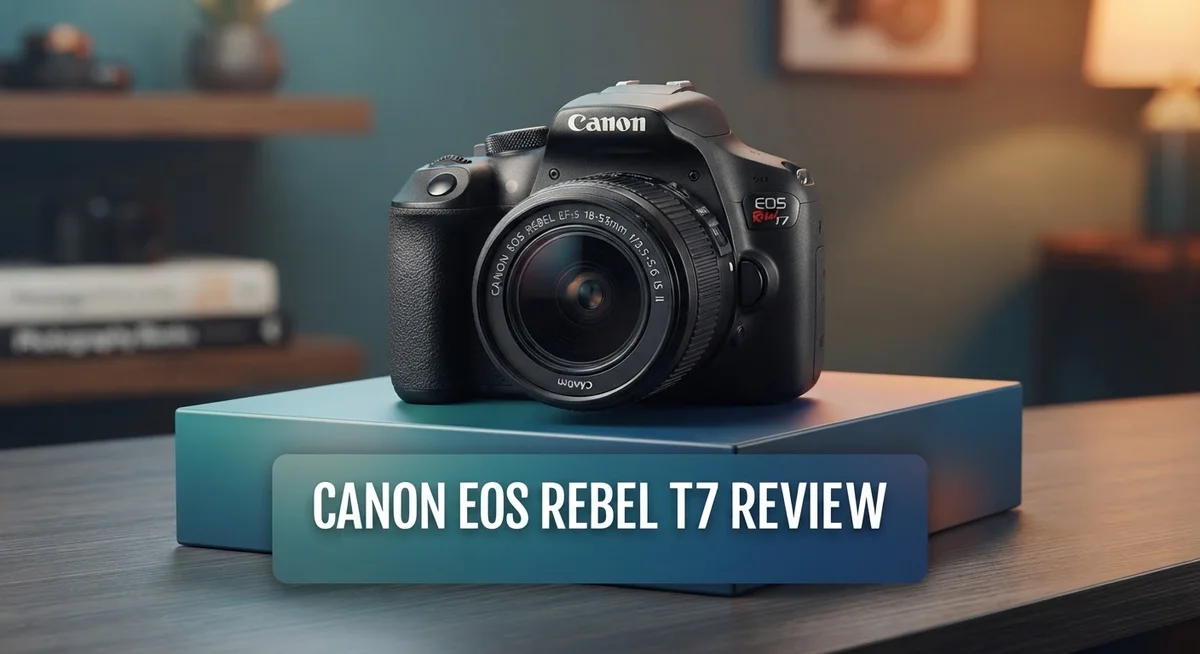
Canon EOS Rebel T7 Review: Should You Buy This?
Are you looking for a simple DSLR camera that just works? The Canon EOS Rebel T7 might be your answer.
This camera brings a 24.1MP APS-C sensor to beginners and hobbyists alike. It captures sharp, detailed photos without a steep learning curve.
The T7 comes with a DIGIC 4+ processor and a handy 18-55mm kit lens. You get everything you need to start shooting great photos right away.
This DSLR earned a solid 4 out of 5 star rating from reviewers. It stands out for its simple controls and reliable image quality.
Sure, it has some limits. The autofocus feels a bit slow. Low light shots can lose detail too.
But for new photographers, these tradeoffs rarely matter. You get a user-friendly camera that teaches you the basics of DSLR photography.
Want to know if the Canon EOS Rebel T7 fits your needs? Let’s break down every feature, pro, and con in detail.
In a Nutshell
Here’s the quick lowdown on the Canon EOS Rebel T7 before you scroll further.
- Best for beginners: This DSLR suits anyone stepping up from a smartphone camera.
- Sharp everyday shots: Photos look crisp for family events, travel, and casual outings.
- Basic autofocus system: The 9-point AF works fine in daylight but struggles to track fast subjects.
- Not built for night shots: Low light scenes show more grain compared to newer models.
- Compact and light: The kit lens keeps the whole setup easy to carry around all day.
- Stacks up against rivals: Models like the Sony A6000 or Canon EOS R100 offer faster processors, but the T7 keeps things simple.
If you want a camera that just works without a steep learning curve, the T7 delivers. It won’t win awards for speed or low light shots. But it handles the basics well, making it a solid pick for anyone starting their photography journey.
Key Features and Specifications
The Canon EOS Rebel T7 packs solid specs that make it a genuine option for people picking up a DSLR for the first time. Let’s dig into what this camera actually does.
Sensor and Processing Power
The 24.1MP APS-C CMOS sensor captures detail across a wide range of scenes. The DIGIC 4+ processor handles image processing quickly enough for everyday shooting. This combo produces clean, sharp images when light conditions are normal or bright.
Autofocus System
The 9-point autofocus system includes a center cross-type point. This works well for stationary subjects and posed shots. Moving subjects or fast action? The AF system takes longer to lock on compared to newer cameras. In daylight, you won’t notice much delay. Indoors or in dim spaces, focusing becomes slower and less reliable.
ISO Range and Low Light
The camera shoots from ISO 100 to 6400 natively, with expansion up to 12800. This range sounds decent on paper. Real world results show more noise and grain in low light than you’d see on newer processors like DIGIC 8. Indoor events or evening photography will reveal this limitation pretty quickly.
Wireless Features
Built in Wi-Fi and NFC make sharing images simple. You can transfer photos to your phone or tablet without cables. This is genuinely handy for uploading to social media or backing up shots on the go.
The Lens
The included EF-S 18–55mm f/3.5–5.6 IS II lens covers most everyday focal lengths. Image stabilization helps reduce blur from hand shake. The lens is lightweight and compact, which keeps the whole kit portable.
Bottom Line on Specs
The T7 delivers solid core features for someone starting out. You get a real APS-C sensor, wireless connectivity, and a capable kit lens. The autofocus and low light performance lag behind pricier models, but beginners shooting in daylight won’t feel held back. The specs match what a new photographer actually needs to learn the basics and create good images.

- 24.1 Megapixel CMOS (APS-C) sensor with is 100–6400 (H: 12800)
- Built-in Wi-Fi and NFC technology

Last update on 2026-09-25 / Affiliate links / Images from Amazon Product Advertising API
Image Quality and Sensor Performance
The Canon EOS Rebel T7 captures images with impressive clarity for an entry-level DSLR. The 24.1MP APS-C sensor records fine details across landscapes, portraits, and everyday scenes. You’ll notice sharp results when shooting in bright daylight conditions.
The DIGIC 4+ processor handles color accuracy and exposure well for standard photography. It processes images fast enough that you won’t experience lag between shots. The sensor’s dynamic range lets you recover detail in both shadows and highlights during editing.
ISO performance shows real strengths and limits. At ISO 100 to 3200, images stay clean with minimal grain. Push to ISO 6400 and noise becomes visible, especially in larger prints. The expandable ISO 12800 option exists for emergency situations but produces softer results.
Low light shooting is where the T7 shows its weaknesses. Indoor events without flash reveal more grain than you’d see on newer Canon models with DIGIC 8 processors. Night photography requires either a tripod with longer exposures or external lighting. This limitation matters less if you shoot mostly outdoors.
Color rendering feels natural and pleasing straight from the camera. Reds and skin tones look accurate without excessive saturation. The T7 applies modest sharpening by default, so images feel crisp without looking overly processed.
The 9-point autofocus system affects image sharpness during action shots. The center cross-type point focuses quickly on stationary subjects. Tracking moving subjects proves slower than modern cameras, so fast-paced sports require manual focus or careful timing.
Real world testing shows the T7 excels at still subjects in good light. Family portraits, travel snapshots, and nature photography all turn out well. The included lens delivers respectable sharpness across its zoom range, though edge softness appears at maximum focal lengths.
Beginners will find the image quality more than adequate for learning photography fundamentals. The camera teaches you exposure, composition, and lighting without overwhelming you with technical complexity. Images from the T7 print beautifully at standard sizes and look great on social media.
Autofocus System and Speed
The autofocus system in the Canon EOS Rebel T7 uses a 9-point setup with a center cross-type sensor. This means the camera focuses most reliably on subjects placed in the middle of your frame. The cross-type point responds better to both horizontal and vertical details, which helps when you’re shooting portraits or structured scenes.
In daylight conditions, the autofocus performs well enough for everyday photography. You’ll get sharp results on stationary subjects like landscapes, family portraits, and still-life shots. The system locks onto your subject quickly when light is plentiful. Single autofocus mode works smoothly for planned shots where your subject stays put.
Speed becomes a real limitation when you move to continuous autofocus or tracking. The DIGIC 4+ processor doesn’t have the power to keep up with fast-moving subjects. If you’re photographing kids running around or sports events, you’ll notice the camera struggles to maintain focus. The autofocus hunts and searches rather than smoothly following action.
Low light autofocus performance drops noticeably. The center cross-type point helps here, but the overall system slows down in dim conditions. You might experience more focus misses indoors or during evening shots. Using manual focus or adding external lighting can help in these situations.
Compared to newer competitors like the Canon EOS R100, the T7’s autofocus feels dated. The R100 uses a more advanced DIGIC 8 processor with better tracking abilities. However, the T7’s basic AF system still serves beginners well for learning photography fundamentals.
For still photography in good light, you won’t feel frustrated by the autofocus speed. The camera responds quickly enough for casual shooting. The real drawback appears only when you need to photograph moving subjects or work in challenging lighting.
If you shoot mostly landscapes, portraits, and stationary scenes, the autofocus system meets your needs. Just understand that fast action and low light are not this camera’s strengths. The T7 remains honest about what it offers: solid autofocus for straightforward, planned photography.
Top 3 Alternatives
Nikon D3500

- Includes all original accessories plus a 90 Day Warranty
- Nikon D3500 24.2MP DSLR Camera with AF-P DX NIKKOR 18-55mm f/3.5-5.6G VR Lens
Last update on 2026-09-26 / Affiliate links / Images from Amazon Product Advertising API
The Nikon D3500 offers excellent image quality for photographers starting their journey. This camera features a 24.2-megapixel sensor that captures sharp, detailed photos in various lighting conditions. The autofocus system works fast and accurately, making it easy to catch moving subjects.
The battery life on this model is outstanding. You can take hundreds of photos on a single charge, which is perfect for long shooting sessions. The ergonomic grip feels comfortable in your hands during extended use.
Canon EOS M50

- Canon USA Authorized. Items Include: Canon EOS M50 Mark II Mirrorless Camera with 15-45mm...
- Capture high-quality images and video with the Canon EOS M50 Mark II featuring a 24.1MP...
Last update on 2026-09-26 / Affiliate links / Images from Amazon Product Advertising API
The Canon EOS M50 brings mirrorless technology to content creators and enthusiasts. This compact camera has a 24.1-megapixel sensor and produces vibrant colors straight from the camera. The articulating touchscreen flips up for vlogging and selfie shots, making it ideal for video content.
Autofocus performance is quick and reliable, especially during video recording. The camera connects easily to your smartphone via Bluetooth for instant file transfer. Built-in Wi-Fi streaming capabilities make sharing your work simple and convenient.
Sony Alpha a6000

- 24 MP APS-C CMOS sensor and Focus Sensitivity Range :EV 0 to EV 20 (at ISO 100 equivalent...
- ISO 100-25600 (expandable to 51200). Lens compatibility- Sony E-mount lenses
Last update on 2026-09-26 / Affiliate links / Images from Amazon Product Advertising API
The Sony Alpha a6000 delivers impressive speed and performance. This mirrorless camera features a 24.3-megapixel sensor with rapid autofocus that locks onto subjects incredibly fast. The continuous shooting rate reaches 11 frames per second, perfect for action photography.
The compact design makes this camera highly portable. You can slip it into a bag without much bulk. The electronic viewfinder provides a real-time preview of your exposure and white balance. Battery performance is decent, though you might want a spare battery for full-day shoots. The lens ecosystem offers plenty of options for expansion and creative possibilities.
Design, Build, and Ergonomics
The Canon EOS Rebel T7 feels comfortable in your hands from the moment you pick it up. The body uses a polycarbonate shell that balances lightweight construction with durability. You won’t feel like you’re holding a flimsy camera, yet it remains portable enough for all-day shooting sessions.
The grip sits naturally on the right side. Your fingers rest in a contoured area that prevents accidental drops. The texture provides enough friction so the camera doesn’t slip during active shooting. Left-handed users may find the button placement slightly awkward, but the overall ergonomics work well for most people.
The T7 measures 5.2 x 3.9 x 2.7 inches and weighs around 18 ounces with the battery and memory card installed. This makes it genuinely portable compared to professional DSLRs. You can carry it in a small shoulder bag or even a large jacket pocket without strain.
The control layout keeps things simple and logical. The mode dial sits on top, letting you switch between automatic and manual modes quickly. The back of the camera houses the four-way directional pad and the menu button. Everything feels intuitive, which matters when you’re learning photography basics.
The viewfinder shows you what the sensor sees, though it’s not the largest in its class. You get a clear view of your composition and can see focus points in real time. The LCD screen on the back flips out slightly but doesn’t rotate fully, which limits certain shooting angles.
Build quality feels solid without being premium. The camera can handle occasional bumps and minor impacts. The shutter mechanism sounds responsive and reliable. Weather sealing is absent, so you’ll want to avoid heavy rain or dusty environments.
The included EF-S 18–55mm lens matches the camera’s weight and balance perfectly. Together, they create a system that beginners can confidently handle for hours without fatigue. The combination prioritizes usability over professional-grade features, which aligns with the camera’s purpose as an entry-level DSLR.
Connectivity and Ease of Use
The Canon EOS Rebel T7 connects to your smartphone and computer with ease. The built-in Wi-Fi lets you transfer photos wirelessly without any cables. NFC support makes pairing even faster if your phone has this feature.
The Canon Connect app works smoothly on both Android and iOS devices. You can view your photos on your phone right after you shoot them. Remote shooting is possible too, so you can trigger the camera from your smartphone.
Transferring images becomes quick and painless. You simply enable Wi-Fi on the camera, open the app, and select which photos to download. The process feels intuitive even if you’ve never used a DSLR before.
The menu system on the T7 keeps things simple and straightforward. Buttons sit in logical places, so you won’t hunt around looking for controls. The LCD screen displays clear menus with large text. New photographers appreciate this no-nonsense approach to navigation.
The learning curve stays gentle. You can shoot in full automatic mode or switch to semi-manual modes as your skills grow. The camera doesn’t overwhelm you with endless options and settings.
USB connectivity works reliably for file transfers and charging. You can plug the camera into any computer and drag files like you would with a regular drive. Battery charging happens through the USB port, which means fewer cables to carry.
The T7 works well with Canon’s ecosystem of lenses and accessories. Swapping lenses takes seconds once you understand the process. The EF and EF-S mount gives you access to thousands of compatible lenses.
Video recording connects easily to external audio devices through the 3.5mm microphone jack. This feature matters if you plan to record interviews or voiceovers. The connection stays stable during longer recording sessions.
Overall, connectivity and ease of use make the T7 beginner-friendly. You won’t face frustrating technical barriers. The camera lets you focus on learning photography instead of wrestling with complicated features.
Pros and Cons
Pros
- Entry-level DSLR that produces excellent image quality for beginners learning photography
- Simple and user-friendly operation keeps the learning curve gentle for new users
- Compact kit lens included works well with the camera’s weight and balance
- Built-in Wi-Fi and NFC let you transfer images to your smartphone and computer quickly
- Solid build quality feels reliable without being premium
Cons
- Autofocus system feels dated compared to newer competitors and struggles with continuous tracking
- Low-light autofocus performance drops noticeably when shooting in dim conditions
- DIGIC 4+ processor lags behind competitors using DIGIC 8 technology
- Viewfinder is not the largest in its class and limits your framing experience
Who Should Buy It
The Canon EOS Rebel T7 works best for specific types of photographers. If you’re just starting your photography journey, this camera makes an excellent first choice. The simple menu system and automatic modes let you focus on learning composition and lighting instead of wrestling with complicated settings.
Students and hobbyists find real value here. You get a genuine DSLR experience without overwhelming complexity. The included lens covers everyday shooting situations. You can take family photos, travel shots, and casual portraits without needing to buy extra equipment right away.
Content creators on social media benefit from the built-in Wi-Fi and NFC features. Transferring images to your phone happens instantly. You can edit and post photos within minutes of shooting them. The camera connects seamlessly to both Android and iOS devices through the Canon Connect app.
Parents who want to document their children’s milestones should consider this model. The autofocus system works reliably in daylight and normal indoor lighting. You’ll capture sharp photos of kids playing sports, school events, and family gatherings. The compact size makes it easy to carry around.
However, you should skip the T7 if you need advanced features. Professional photographers require faster autofocus and better low-light performance. The 9-point autofocus system struggles with continuous tracking of moving subjects. Sports photographers and wildlife enthusiasts need something more capable.
People who shoot frequently in dim environments should look elsewhere. The DIGIC 4+ processor doesn’t handle high ISO noise as well as newer competitors. Concert photography and indoor events become challenging.
If you want cutting-edge technology, the newer Canon EOS R100 offers better processing power and mirrorless advantages. The T7 serves a clear purpose though. It introduces photography to beginners without intimidating them. It delivers solid image quality for everyday use. The learning curve stays manageable. You progress at your own pace without feeling rushed to understand advanced concepts.
The T7 shines as an educational tool and a reliable companion for casual shooting.
Final Verdict
The Canon EOS Rebel T7 earns a solid 4 out of 5 stars from expert reviewers. This score reflects a camera that does its job well for its intended audience.
This DSLR shines as a starting point, not a final destination. It gives new photographers a strong foundation to build skills on.
Think of the T7 as a stepping stone. Many photographers use it to learn composition, exposure, and lighting basics before moving to advanced gear.
The camera’s straightforward design means less time fumbling with settings. More time goes into actually taking photos and enjoying the process.
Compared to rivals like the Sony A6000 or Canon’s own 77D and 80D, the T7 keeps things simple. It skips complex features that can overwhelm someone new to DSLRs.
The newer Canon EOS R100 represents where mirrorless technology is heading. But the T7 still holds its ground as a dependable traditional DSLR option.
For photography classes, family documentation, or casual hobby shooting, this camera delivers what it promises. It won’t replace professional gear, but that’s not its goal.
Longevity matters too. The T7 works with Canon’s wide lens lineup, so your investment in lenses carries forward if you upgrade later.
Should you buy it? If you’re starting your photography journey, yes. The T7 handles the basics with confidence and keeps frustration low.
Skip it if you need speed. Sports photographers, wildlife shooters, or anyone needing fast autofocus should look at newer models instead.
The final take is simple. This camera fits beginners, students, and casual shooters perfectly. It teaches real photography skills without unnecessary complexity.
Advanced users will outgrow it fast. But for its target audience, the T7 remains a smart, capable choice that gets the fundamentals right.
Frequently Asked Questions
Does the Canon EOS Rebel T7 work for professional photography?
The T7 is built for beginners and hobbyists, not professionals. The camera excels at helping you learn the fundamentals of photography. However, professionals need faster autofocus, more advanced metering, and superior low-light performance. The DIGIC 4+ processor also lags behind what professionals expect from modern equipment.
If you’re starting a photography business, consider upgrading to the Canon EOS 77D, 80D, or the newer mirrorless Canon EOS R100 instead.
Can you shoot video on the Canon EOS Rebel T7?
Yes, the T7 records Full HD video at 30fps. The camera includes autofocus during video recording, though it moves slowly and can hunt for focus. Audio recording works through the built-in microphone or an external mic jack.
Video quality is decent for social media content and personal projects. Serious videographers will want a camera with faster autofocus and better stabilization.
How does the T7 perform in low light situations?
Low-light shooting is the T7’s weak spot. The camera struggles when you shoot indoors or at dusk. Autofocus performance drops noticeably in dim conditions, and you’ll need to bump up the ISO, which introduces more grain to your images.
For events or indoor photography, bring extra lighting or plan to use faster lenses. The kit lens maxes out at f/3.5, which limits light gathering.
Is the Canon EOS Rebel T7 better than the Sony A6000?
Both cameras serve beginners well, but they differ in approach. The T7 uses a DSLR design and feels more traditional. The Sony A6000 is mirrorless, compact, and offers better autofocus. The A6000 also performs better in low light.
Choose the T7 if you prefer simplicity and the DSLR form factor. Pick the Sony if you want modern technology and portability.

I’m Lipi, a passionate blogger with a keen interest in artificial intelligence and its applications. On my blog, lipiai.blog, I share information about AI, review different AI tools, and provide helpful guides. My goal is to make AI easy to understand for everyone. I enjoy simplifying complex ideas so that both beginners and tech-savvy folks can learn.