
Hasselblad X1D-50C Review 2026: Still Worth Buying?
The Hasselblad X1D-50C changed everything for medium format photography. It proved that a 50-megapixel medium format sensor could live inside a body small enough to carry all day.
But does it hold up in 2026? With newer cameras flooding the market, the X1D-50C now sits at a very attractive price point on the used and refurbished market. This makes it a tempting choice for photographers who want medium format quality without spending a fortune.
In this review, we break down every aspect of the Hasselblad X1D-50C. We cover image quality, build, autofocus, lens options, and real-world performance. By the end, you will know if this camera deserves a spot in your bag this year.
Key Takeaways
- The Hasselblad X1D-50C features a 51.4-megapixel CMOS sensor that measures 43.8 x 32.9mm. This is 1.66 times larger than a full-frame sensor. The extra sensor size delivers smoother tonal transitions, better color depth, and more detail in every shot.
- 16-bit color and 14 stops of dynamic range set this camera apart from nearly every full-frame competitor. Shadow recovery and highlight retention remain impressive even by 2026 standards. RAW files hold a remarkable amount of information.
- Hasselblad Natural Color Solution (HNCS) gives this camera a distinct color signature. Skin tones look natural and lifelike straight out of camera. Many portrait and fashion photographers consider this a major advantage over other brands.
- The body weighs just 725 grams, which was groundbreaking for medium format at launch. It remains one of the lightest medium format cameras you can buy. The compact size makes it ideal for travel and location work.
- Autofocus and startup speeds are slower than modern full-frame mirrorless cameras. This is the camera’s biggest weakness. It works best for deliberate, planned shooting rather than fast action.
- The used market price has dropped significantly, making the X1D-50C one of the most affordable ways to enter the Hasselblad ecosystem. You can often find clean examples for a fraction of the original retail price.
Hasselblad X1D-50C Overview

- 43.8 × 32.9mm, 50 megapixels CMOS sensor(8272 × 6200 pixels, 5.3 × 5.3 μm)
- 3.0 inch TFT type, 24 bit color, 920K pixel Touchscreen Display
Last update on 2026-11-10 / Affiliate links / Images from Amazon Product Advertising API
The Hasselblad X1D-50C arrived in 2016 as the first mirrorless medium format camera from Hasselblad. It shocked the photography world with its compact size and premium build. No one expected medium format to fit in such a small package.
Hasselblad designed this camera for photographers who want the best image quality in a portable body. The 51.4-megapixel sensor captures files with incredible detail and tonal range. It uses the XCD lens mount, which supports a growing line of high-quality lenses.
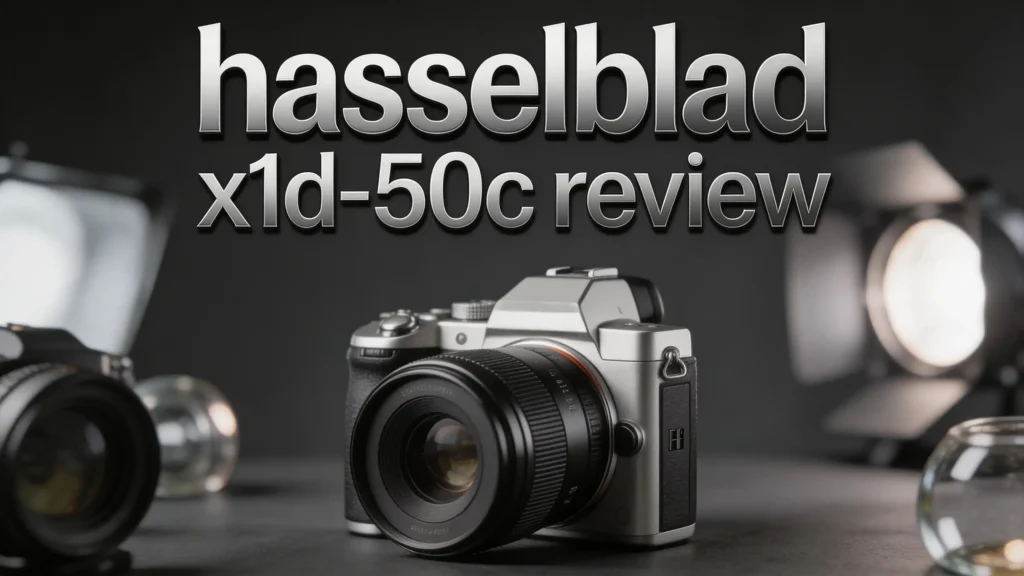
The camera body features a clean, minimalist design with a 3-inch touchscreen LCD and a 2.36-megapixel electronic viewfinder. Every control feels deliberate and well-placed. Hasselblad built this camera to slow you down and focus on the craft of photography.
In 2026, the X1D-50C represents an entry point into medium format at a price that was unthinkable a few years ago. It remains a capable tool for studio, landscape, and portrait photographers who prioritize image quality above all else.
Build Quality and Design
Hasselblad has a reputation for building beautiful cameras. The X1D-50C lives up to that legacy. The body uses a precision-milled aluminum shell that feels solid and premium in hand.
The camera weighs 725 grams without a lens. This makes it lighter than many full-frame DSLRs. You can carry it around your neck for hours without fatigue. The grip is shallow but functional, and the overall ergonomics favor style alongside substance.
Every button and dial has a satisfying click. The dual control dials on the top plate give you quick access to aperture and shutter speed. The minimalist layout means fewer distractions and more focus on your subject.
The weather sealing on the X1D-50C covers the basic entry points. It can handle light rain and dust, but you should avoid extreme conditions. The lens mount features a solid metal construction that inspires confidence with every lens swap.
Sensor and Image Quality
The 43.8 x 32.9mm CMOS sensor is the heart of this camera. At 51.4 megapixels, it produces files measuring 8272 x 6200 pixels. Each pixel measures 5.3 micrometers, which is significantly larger than full-frame pixels.
Larger pixels collect more light. This results in cleaner images with less noise at higher ISO settings. The X1D-50C handles ISO values up to 25,600, though the sweet spot sits between ISO 100 and 3200. Files at ISO 6400 remain very usable with moderate noise reduction.
The 16-bit color depth gives this camera a massive advantage in post-processing. You get smoother gradients and richer color transitions compared to 14-bit full-frame cameras. This matters a lot for skin tones, skies, and subtle color work.
Dynamic range reaches up to 14 stops, which means you can recover shadows and pull back highlights with remarkable flexibility. Landscape and architectural photographers will love the latitude these RAW files provide. The image quality remains competitive with cameras released years later.
Hasselblad Natural Color Solution
Hasselblad developed its Natural Color Solution (HNCS) to deliver accurate, true-to-life colors. This system uses advanced color calibration built into the camera’s processing pipeline. The result is colors that look natural without heavy editing.
Skin tones are the standout feature. Portraits shot on the X1D-50C have a warmth and realism that many photographers describe as “film-like.” The camera renders reds, oranges, and subtle flesh tones with beautiful accuracy. This saves hours of color correction in post-production.
HNCS also handles difficult mixed lighting well. Indoor scenes with warm tungsten and cool daylight produce pleasing results straight from the camera. The white balance system works hand-in-hand with HNCS to deliver consistent color across different shooting environments.
Fashion and commercial photographers especially appreciate this feature. When your client needs accurate product colors or true-to-life skin, the X1D-50C delivers without extra effort. This color science remains one of Hasselblad’s strongest selling points in 2026.
Top 3 Alternatives for Hasselblad X1D-50C
If the X1D-50C does not match your needs, here are three strong alternatives in the medium format space.
Fujifilm GFX 50S offers a similar 51.4-megapixel sensor in a larger but more ergonomic body. It has faster autofocus and more lens options. The GFX system provides excellent value for medium format shooters.

- 43.8mm x 32.9mm, 51.4 MP CMOS sensor, boasting Approx. 1.7x the area of full frame sensors...
- Operating temperature -10°C - +40°C (+14°F - +104°F)C.Compact and lightweight body...
Last update on 2026-11-10 / Affiliate links / Images from Amazon Product Advertising API
Fujifilm GFX 50R packs the same sensor into a rangefinder-style body. It is compact, lightweight, and perfect for street and travel photography. The GFX 50R gives you medium format quality in an even more portable design.

- 51.4MP medium format 43.8 x 32.9mm sensor for superior sharpness and image quality w...
- Fujifilm g mount with short Flange back distance of just 26.7mm
Last update on 2026-11-10 / Affiliate links / Images from Amazon Product Advertising API
Pentax 645Z is a 51-megapixel medium format DSLR with fast autofocus and excellent weather sealing. It offers a more traditional shooting experience with an optical viewfinder. The Pentax lens library for the 645 mount is extensive and affordable.

- 51.4 effective mega-pixel CMOS sensor
- Class leading speed and response with 3FPS frame rate
Last update on 2026-11-10 / Affiliate links / Images from Amazon Product Advertising API
Autofocus Performance
The autofocus on the X1D-50C uses a contrast-detection system. This means the camera hunts for focus by analyzing contrast in the scene. It works well for still subjects, studio work, and landscapes.
Speed is the biggest trade-off. The autofocus is noticeably slower than what you find on modern full-frame mirrorless cameras. It can take a moment to lock on, especially in low light. Moving subjects present a real challenge for this system.
The camera offers single-point AF and multi-point AF modes. Single-point AF gives you the most accurate results. You can move the focus point anywhere on the touchscreen, which adds flexibility during composition.
For portrait work, the AF performs well enough. Your subject needs to stay relatively still, but the results are accurate once the camera locks on. Street photographers and sports shooters should look elsewhere. The X1D-50C rewards patience and a deliberate approach to image-making.
Video Capabilities
The X1D-50C shoots Full HD 1080p video at 25 frames per second using H.264 compression. This was not a video-focused camera at launch, and it remains limited in this area today.
Video footage looks clean with good color reproduction, thanks to the large sensor and HNCS. You get pleasant depth of field and nice bokeh in motion. However, the 25fps cap and lack of 4K make it outdated for serious video work in 2026.
There is no continuous autofocus during video recording. You need to manually pull focus or pre-focus before recording. This limits the camera to controlled video setups where manual focus is acceptable.
Audio input is available through a 3.5mm microphone jack. You can connect an external microphone for better sound quality. Overall, the video function works as a secondary feature, but dedicated videographers should consider other options.
XCD Lens System
The Hasselblad XCD lens system was created specifically for the X1D platform. These lenses feature built-in central leaf shutters that allow flash sync at all shutter speeds. This is a huge advantage for studio photographers.
The XCD lineup includes focal lengths from 21mm to 135mm (in medium format equivalent). Popular options include the XCD 45mm f/3.5 and the XCD 90mm f/3.2. Both lenses deliver razor-sharp images with beautiful rendering.
Every XCD lens is compact and lightweight. Hasselblad designed them to match the portable philosophy of the X1D body. The optical quality is outstanding across the entire range, with minimal distortion and chromatic aberration.
The leaf shutter design lets you sync flash at speeds up to 1/2000th of a second. This is perfect for outdoor portraits with fill flash. You can overpower the sun without needing ND filters or high-speed sync. This feature alone makes the XCD system special.
Battery Life and Power Management
Battery life is one of the weaker points of the X1D-50C. The rechargeable lithium-ion battery delivers around 200 shots per charge under standard conditions. Heavy use of the touchscreen and EVF will drain the battery faster.
Hasselblad provides a USB charging option. You can top off the battery using a standard USB connection, which is convenient for travel. Carrying at least two spare batteries is a smart choice for any extended shoot.
The camera enters sleep mode quickly to conserve power. Wake-up time from sleep takes a few seconds, which can cause you to miss fleeting moments. You can adjust the sleep timer settings, but shorter times improve battery life at the cost of responsiveness.
Power management has improved slightly through firmware updates over the years. Still, plan your shooting sessions around battery swaps if you rely on this camera for a full day of work. A charging grip or portable USB power bank helps extend your shooting time.
Touchscreen and User Interface
The X1D-50C features a 3.0-inch touchscreen display with 920,000 dots. The touch interface allows you to swipe through menus, set focus points, and review images. It responds smoothly to gestures and taps.
Hasselblad designed the menu system with simplicity in mind. Options are laid out in a clean, intuitive grid. You can access ISO, white balance, image format, and other settings with just a few taps. The learning curve is short, even for first-time Hasselblad users.
The electronic viewfinder has a resolution of 2.36 million dots. It provides a clear view of your scene with accurate color representation. The EVF refresh rate is adequate but not as smooth as newer cameras from Sony or Canon.
One standout feature is the ability to pinch-to-zoom during image review on the touchscreen. This makes checking focus and fine details fast and easy. The overall user experience feels modern and refined, though some photographers prefer more physical buttons.
Connectivity and Workflow
The X1D-50C supports Wi-Fi and USB 3.0 Type-C for data transfer and tethered shooting. Wi-Fi lets you connect to a smartphone or tablet for remote control and image transfer. The Hasselblad Phocus Mobile app works well for basic remote shooting tasks.
Tethered shooting via USB 3.0 is fast and reliable. Studio photographers can send images directly to a computer running Hasselblad Phocus software. Phocus offers excellent RAW processing with full support for HNCS color profiles.
The camera uses a single SD card slot (UHS-I). This was a common criticism at launch. Write speeds are acceptable but not blazing fast. A high-quality SD card helps maximize performance during continuous shooting.
RAW files from the X1D-50C are compatible with Adobe Lightroom, Capture One, and other popular editing software. The 3FR RAW format preserves all the sensor data for maximum flexibility in post-processing. Files average around 60 to 70 megabytes each, so bring plenty of storage.
Who Should Buy the X1D-50C in 2026
The Hasselblad X1D-50C suits a specific type of photographer. If you shoot landscapes, portraits, fashion, or fine art, this camera delivers results that few full-frame systems can match. The image quality remains stunning even by today’s standards.
Budget-conscious photographers looking for medium format should pay close attention. Used X1D-50C bodies sell for a fraction of their original price. This puts Hasselblad-level quality within reach of enthusiasts and semi-professionals.
This camera is not for everyone. Action shooters, wildlife photographers, and videographers will find it too slow. The autofocus system and burst rate cannot keep up with fast subjects. The limited video specs also rule it out for content creators.
If you value deliberate, thoughtful photography with the best possible image quality, the X1D-50C still makes sense. It forces you to slow down and engage with your subject. Many photographers find that this slower pace actually improves their work.
Firmware Updates and Longevity
Hasselblad has released several firmware updates for the X1D-50C since its launch. These updates improved autofocus speed, fixed bugs, and added new features. The most recent updates brought better stability and improved touchscreen responsiveness.
The camera’s processor limits how much improvement firmware can deliver. You will not see a dramatic speed boost from software alone. However, the updates show that Hasselblad supports its products over the long term.
Lens compatibility continues to expand. Newer XCD lenses work perfectly with the original X1D-50C body. You also get access to adapters for Hasselblad HC/HCD lenses, which opens up a huge library of medium format glass.
In terms of build longevity, the X1D-50C holds up well. The aluminum body resists wear, and the electronic components remain reliable. With proper care, this camera can serve you for many more years. It is a solid long-term investment for any serious photographer.
Hasselblad X1D-50C vs. X1D II 50C

- X1D II 50C 50MP Medium Format Mirrorless Camera Body - Battery - USB Power Adapter - USB...
- 50 MP Medium Format Sensor
Last update on 2026-11-10 / Affiliate links / Images from Amazon Product Advertising API
The X1D II 50C arrived as the successor to the original X1D-50C. It uses the same 51.4-megapixel sensor but adds meaningful upgrades. The most important change is a 20 to 30 percent improvement in speed across startup, shutter lag, and menu responsiveness.
The X1D II also features a larger 3.6-inch rear LCD compared to the 3.0-inch screen on the original. The electronic viewfinder received an upgrade to 3.69 million dots, which provides a sharper and more detailed view. These changes improve the daily shooting experience.
Image quality between the two cameras is essentially identical. Both produce the same gorgeous files with the same color science and dynamic range. If image quality is your only concern, the original X1D-50C saves you money with zero compromise.
The X1D II costs more on the used market. The question becomes whether the speed and usability improvements justify the extra expense. For studio and landscape shooters, the original model remains a fantastic value. For photographers who need better responsiveness, the X1D II is worth the upgrade.
Pros and Cons Summary
The Hasselblad X1D-50C earns praise for its exceptional image quality, beautiful design, and compact medium format body. The 16-bit color depth, 14 stops of dynamic range, and Natural Color Solution produce files that stand apart from full-frame cameras. The XCD lens system with its leaf shutters offers creative advantages for flash photography.
On the downside, the camera suffers from slow autofocus, limited battery life, and a single SD card slot. Video capabilities lag behind modern standards. The startup time and general responsiveness feel dated compared to current mirrorless cameras.
At its current used market price, the pros far outweigh the cons for the right photographer. You get Hasselblad quality and craftsmanship at a fraction of the original cost. The trade-offs are real but manageable for photographers who shoot with intention and care.
The X1D-50C is not a do-everything camera. It excels in specific areas and struggles in others. Understanding this balance helps you decide if it belongs in your kit.
Final Verdict
The Hasselblad X1D-50C remains a remarkable camera in 2026. Its image quality has aged gracefully, and its files still compete with modern systems. The color science and tonal depth continue to set a high standard for digital photography.
This camera rewards photographers who embrace a slower, more thoughtful workflow. It produces images with a distinct character that full-frame cameras simply cannot replicate. The medium format advantage is real and visible in every properly exposed frame.
If you can work within its limitations, the X1D-50C offers one of the best value propositions in medium format photography today. It delivers Hasselblad heritage, Swedish craftsmanship, and world-class image quality at an accessible price. For landscape, portrait, and fine art photographers, it remains an excellent choice.
Frequently Asked Questions
Is the Hasselblad X1D-50C still worth buying in 2026?
Yes, the X1D-50C offers outstanding image quality that holds up well in 2026. The 51.4-megapixel medium format sensor, 16-bit color depth, and 14 stops of dynamic range produce files that rival cameras released years later. Its current used market price makes it one of the most affordable paths into medium format photography.
How does the Hasselblad X1D-50C compare to the Fujifilm GFX 50S?
Both cameras share a similar 51-megapixel medium format sensor size. The GFX 50S offers faster autofocus, more lens options, and better battery life. The X1D-50C delivers Hasselblad’s Natural Color Solution and a more compact body design. The choice depends on whether you value color science and portability or speed and versatility.
Can the Hasselblad X1D-50C shoot video?
The X1D-50C records Full HD 1080p video at 25fps. It lacks 4K capability and continuous autofocus during recording. The video function works for basic clips and behind-the-scenes footage, but serious videographers should consider other cameras. Video was not a priority in this camera’s design.
What lenses work with the Hasselblad X1D-50C?
The camera uses the Hasselblad XCD lens mount. All XCD lenses are fully compatible, with options from 21mm to 135mm. You can also use HC and HCD lenses with an adapter for even more focal length choices. Every XCD lens includes a built-in leaf shutter for full flash sync speed.
How many shots can I get on a single battery charge?
The X1D-50C delivers approximately 200 shots per battery charge under normal shooting conditions. Heavy use of the EVF and touchscreen reduces this number. Carrying two or three spare batteries is recommended for full-day shoots. USB charging is available for convenient power top-ups.
Is the Hasselblad X1D-50C good for portrait photography?
The X1D-50C is excellent for portrait work. The large sensor produces beautiful background separation and smooth bokeh. Hasselblad’s Natural Color Solution renders skin tones with remarkable accuracy and warmth. The leaf shutter in XCD lenses allows high-speed flash sync, which is ideal for outdoor portrait sessions.

I’m Lipi, a passionate blogger with a keen interest in artificial intelligence and its applications. On my blog, lipiai.blog, I share information about AI, review different AI tools, and provide helpful guides. My goal is to make AI easy to understand for everyone. I enjoy simplifying complex ideas so that both beginners and tech-savvy folks can learn.