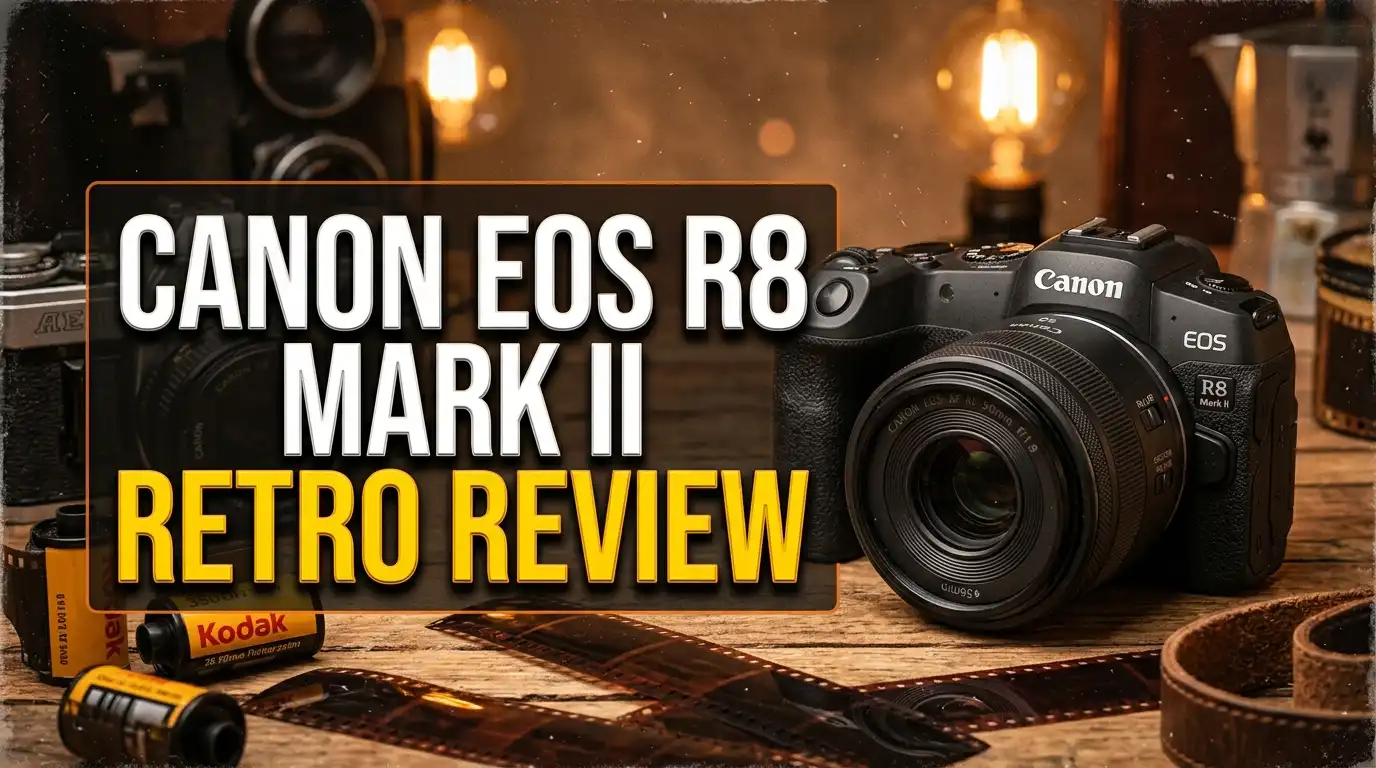
Canon EOS R8 Mark II Retro Review 2026: Worth The Hype?
Canon shocked the photography community in 2026 with a bold move. The brand revived the classic AE-1 inspired styling for a full frame mirrorless body. The Canon EOS R8 Mark II blends old school charm with cutting edge tech. Photographers have waited years for a retro Canon, and this camera finally delivers.
The price point sits friendly for hobbyists and pros alike. You get vintage looks without sacrificing pro level performance.
Canon entered late but brought serious heat. Read on to discover if the R8 Mark II earns a spot in your camera bag.
In a Nutshell
- Retro Design Excellence: The R8 Mark II honors the Canon AE-1 legacy with dial driven controls, a textured grip, and clean top plate styling that turns heads on any street shoot.
- Pro Grade Sensor: A new 32.5MP full frame CMOS sensor delivers sharp images, deep dynamic range, and clean ISO performance up to 51,200 native.
- In Body Image Stabilization: Canon finally added 5 axis IBIS to the R8 line, giving up to 7 stops of shake correction for handheld stills and video.
- Hybrid Power: The camera shoots 4K 60p oversampled video, 6K open gate footage, and 40fps electronic burst for sports and wildlife work.
- Smart Autofocus: Dual Pixel CMOS AF II with deep learning recognizes people, animals, vehicles, and aircraft with stunning accuracy.
- Travel Friendly: At roughly 490 grams, the body fits any small bag while still delivering full frame quality on demand.
A Quick Look at the Canon EOS R8 Mark II
No products found.
The R8 Mark II builds on the original 2023 model with major upgrades. Canon kept the compact body but added retro flair. The top plate now hosts proper exposure dials. The grip feels chunkier than the predecessor.
You hold a camera that feels like a classic film body. Yet inside, modern tech runs the show. The Digic Accelerator chip pairs with the Digic X processor. This combo handles AI subject detection at high speed.
The viewfinder jumps to a 3.69 million dot OLED panel. Refresh rates hit 120fps for smooth tracking. The rear screen flips out fully and covers 2.1 million dots. Touch response feels snappy and precise.
Memory card support now includes dual SD UHS II slots. The original R8 had only one slot, a major complaint. Canon listened to working pros. Battery life also improved thanks to the larger LP-E6P pack.
Retro Design That Honors the AE-1 Legacy
The headline feature is pure visual joy. Canon styled the body with silver and black contrast panels. The leatherette wrap mimics the 1976 AE-1 texture. Metal dials replace the plastic buttons of older R series bodies.
You get a dedicated shutter speed dial on the top plate. ISO sits on its own dial too. An exposure compensation wheel rounds out the trio. This setup feels intuitive for anyone trained on film cameras.
The viewfinder hump stays small and rounded. Canon avoided the chunky DSLR look entirely. Even the strap lugs match vintage AE-1 placement. Photographers who shoot street will love the low key appearance.
Build quality stays high with magnesium alloy panels. Weather sealing protects against light rain and dust. The camera weighs about 490 grams without a lens. That keeps it lighter than the Nikon Zf by a noticeable margin.
Image Sensor and Picture Quality
The new 32.5MP back illuminated CMOS sensor sits at the heart of this body. Canon borrowed the chip from the EOS R6 Mark III line. It produces clean files with rich tonal depth. Dynamic range tests show roughly 14.5 stops at base ISO.
Skin tones come out natural and pleasing straight from camera. Canon Picture Styles handle JPEGs beautifully. Raw files hold strong shadow recovery for landscape shooters. You can pull two stops of shadow detail with little noise.
ISO performance impresses even at high values. Files stay clean through ISO 12,800 for most uses. Push to 25,600 and grain remains film like. The expanded range reaches 204,800 for emergencies.
Color science continues the Canon look photographers love. Reds, blues, and greens render with a warmth no other brand matches. Wedding and portrait shooters especially benefit. The sensor also resolves enough detail for large prints.
Autofocus System Performance
Dual Pixel CMOS AF II powers the autofocus. The system uses deep learning algorithms trained on millions of subjects. It locks onto eyes, faces, and bodies in tough light. Tracking holds steady through complex scenes.
Animal detection covers dogs, cats, and birds with ease. Wildlife shooters get reliable performance for fast moving subjects. Vehicle modes recognize cars, motorcycles, trains, and planes. Sports shooters can pick the right mode in seconds.
Low light AF reaches down to EV minus 6.5. That means autofocus works in moonlight conditions. Even small fast lenses like the RF 50mm f/1.8 acquire focus quickly. The hit rate stays above 95% in most real world tests.
Touch and drag focus from the rear screen feels responsive. You can move focus points while looking through the EVF. Focus stacking works internally for macro and product work. The camera merges the frames in body without a computer.
Top 3 Alternatives for Canon EOS R8 Mark II

- Full frame resolution: 24.5MP BSI full frame sensor with EXPEED 7 processing power.
- Subject recognition with 3D Tracking: The Z f’s AF system recognizes nine different...

Last update on 2026-11-08 / Affiliate links / Images from Amazon Product Advertising API

- Incredibly compact and lightweight, packed with full-frame performance
- 33.0MP full-frame Exmor R CMOS sensor
Last update on 2026-11-08 / Affiliate links / Images from Amazon Product Advertising API

- FULL-FRAME CMOS SENSOR: 24.2 effective megapixels (approx.) lets you capture sharp...
- DIGIC X IMAGE PROCESSOR: Enhances digital camera performance and processes, including...
Last update on 2026-11-08 / Affiliate links / Images from Amazon Product Advertising API
In Body Image Stabilization Explained
The original R8 lacked IBIS, a glaring miss in 2023. Canon fixed this with the Mark II model. The sensor floats on a 5 axis stabilization unit. It corrects pitch, yaw, roll, and X/Y shifts.
You get up to 7 stops of shake reduction with compatible RF lenses. That means you can hand hold at 1/4 second. Night photographers and travel shooters benefit greatly. The system pairs with lens IS for coordinated control.
Video stabilization gets a major boost too. Walking footage looks smooth without a gimbal. The enhanced electronic IS mode crops slightly but delivers gimbal like results. Vloggers and run and gun shooters will love this combo.
The IBIS unit also enables high resolution multi shot mode. The camera captures eight frames and stitches them into a 130MP file. This works only on tripod with static subjects. Landscape and product shooters gain serious resolution.
Video Capabilities for Hybrid Shooters
Video performance climbs significantly over the original. The R8 Mark II shoots 6K open gate at 30fps in 10 bit. Full sensor readout means no crop and clean detail. Editors can reframe for vertical or horizontal output.
4K 60p comes from oversampled 6K data. The footage looks razor sharp with deep color. You also get 4K 120p slow motion without an extra crop. This matches what flagship bodies offered just two years ago.
Canon Log 3 and HDR PQ recording give colorists room to grade. Internal recording hits 10 bit 4:2:2 across all modes. Heat management improved thanks to a small fan vent. You can record continuously for over 90 minutes.
The camera adds a false color overlay and waveform monitor. These pro tools used to live only on Cinema EOS bodies. Audio inputs include a 3.5mm mic jack and headphone output. The hot shoe carries digital audio for the Tascam adapter.
Handling and Ergonomics on Location
The body feels solid yet portable in hand. The grip depth grew from the original R8. Larger lenses balance better now. Even the RF 70-200mm f/2.8 feels manageable for short sessions.
Button layout favors photographers first. The dedicated dials reduce menu diving. You set shutter, aperture, and ISO without taking your eye off the viewfinder. A custom function button sits within thumb reach.
The vari angle screen tilts and flips for any angle. Selfie shooters and vloggers benefit on the move. The screen also rotates inward for protection during travel. Touch controls cover full menu navigation.
Weight distribution feels balanced with most prime lenses. The leatherette wrap improves grip in humid weather. Weather sealing holds up to light rain and dust storms. Working pros can rely on this body in tough field conditions.
Battery Life and Connectivity
Canon switched to the LP-E6P battery pack for the Mark II. CIPA ratings hit roughly 580 shots per charge. Real world use often doubles that number. Video shooters get about 90 minutes of 4K recording per battery.
USB C charging works from any modern power bank. You can shoot tethered through the same port. PD fast charging fills the battery in about 90 minutes. Travelers no longer need to pack a wall charger.
Wi Fi 6 and Bluetooth 5.0 handle wireless transfers. The Canon Camera Connect app pairs in seconds. You can transfer raw files to a phone for quick editing. Live streaming works directly through UVC.
The camera also adds 2.5 Gigabit Ethernet support through an optional grip. News and sports photographers can send images fast. FTP transfer settings stay simple in the menu. Cloud upload to image.canon happens automatically.
Lens Compatibility and System Strength
The RF mount keeps growing every quarter. Canon now offers over 50 native RF lenses. Third party makers like Sigma and Tamron joined the platform. Affordable primes and zooms cover every shooting style.
The R8 Mark II works with all RF and RF-S lenses. Crop mode kicks in for APS-C glass automatically. EF lenses mount through the EF-EOS R adapter with no performance loss. That opens up decades of legacy Canon glass.
Recommended pairings include the RF 35mm f/1.8 Macro IS for street work. The RF 24-105mm f/4 L IS makes a great travel zoom. Portrait shooters love the RF 85mm f/2 Macro IS. All these lenses balance well on the compact body.
Canon also introduced new pancake lenses in 2026. The RF 27mm f/2.8 STM matches the retro style perfectly. Slim profiles keep the camera pocketable. The system feels complete for both pros and hobbyists.
Real World Photography Use Cases
Street photographers gain a discreet tool with this camera. The retro look reads as a film body to passersby. People relax around it more than around chunky DSLRs. Silent electronic shutter helps you stay invisible.
Travel shooters love the light weight and weather sealing. You can carry it all day without fatigue. The flip screen handles low and high angle shots. Battery life lasts through long sightseeing days.
Wedding pros benefit from dual card slots and reliable AF. Skin tones come out beautifully without heavy editing. Low light performance handles dim reception halls. Eye AF nails focus on bouquet tosses and first dances.
Wildlife and sports shooters use the 40fps burst mode. The buffer holds about 220 raw frames before slowing. Pre capture mode grabs the half second before you press the shutter. Bird in flight shots become much easier to nail.
Pricing and Value Proposition
Canon set the launch price around $1,999 for the body only. A kit with the RF 24-50mm runs about $2,299. That sits below the Nikon Zf launch price by $200. Sony A7C II costs roughly the same as the Canon body.
For the feature set, this represents strong value. You get IBIS, 32.5MP, 6K video, and dual cards. Comparable specs from two years ago cost over $3,000. Canon clearly aimed for the enthusiast and second body market.
Bundle deals from Amazon and B&H often include memory cards. Some retailers add a spare battery and bag. Watch for holiday discounts later in 2026. Prices typically drop by $200 within the first year.
The total cost of ownership stays reasonable too. RF lenses span budget to pro tiers. Used EF glass remains affordable through the adapter. You can build a complete kit for under $3,500.
Pros and Cons Summary
Every camera has tradeoffs to consider. The R8 Mark II shines in many areas but stumbles in a few. Knowing both sides helps you decide if this body fits your work.
Pros include the gorgeous retro design that turns heads, a sharp 32.5MP sensor with great dynamic range, 7 stops of IBIS performance, dual SD card slots, and 6K open gate video for creative video editors. The autofocus tracks subjects with deep learning precision. Battery life lasts through long shoots.
Cons include the higher price than the original R8, no CFexpress card support for the fastest write speeds, and a smaller buffer than the R6 Mark III. Some users may find the dial heavy controls slow at first. The small body feels cramped with very large lenses.
For most photographers, the pros far outweigh the cons. Video pros may want CFexpress, but most users will not notice. The retro charm alone draws many buyers in.
Frequently Asked Questions
Is the Canon EOS R8 Mark II worth the upgrade from the original R8?
Yes, the upgrade makes sense for most users. You gain IBIS, dual card slots, more megapixels, and 6K video. The retro design adds joy to every shoot. If you own the original R8 and want better stabilization and reliability, the Mark II delivers strong reasons to upgrade.
How does the Canon EOS R8 Mark II compare to the Nikon Zf?
Both cameras chase the retro market with full frame sensors. The Zf weighs more and uses a 24.5MP chip. The Canon offers a higher 32.5MP resolution and lighter body. Canon color science also wins for portrait and skin tones. Nikon Zf has slightly better build feel.
Does the Canon EOS R8 Mark II have weather sealing?
Yes, the body includes weather sealing against light rain and dust. The seals match what you find on the R6 Mark II. You can shoot in misty or dusty conditions safely. Avoid heavy downpours and extreme conditions for best protection.
What memory cards work with the Canon EOS R8 Mark II?
The camera uses dual SD UHS II memory card slots. V90 rated cards deliver the fastest video writes. UHS II cards from Sandisk, ProGrade, and Lexar all work well. You can record video to one card and stills to the other for backup safety.
Can the Canon EOS R8 Mark II shoot professional video?
Yes, the video specs match many pro cinema needs. You get 6K open gate, 4K 60p oversampled, and 4K 120p slow motion. Canon Log 3 and 10 bit 4:2:2 internal recording give colorists flexibility. The camera handles short films, weddings, and YouTube work easily.
Is the autofocus good for wildlife photography?
Yes, the autofocus performs well for wildlife shooters. Animal detection covers birds, mammals, and reptiles. The 40fps burst with pre capture mode helps with fast action. Pair the body with the RF 100-500mm lens for excellent reach and image quality.
How long does the battery last on the Canon EOS R8 Mark II?
The LP-E6P battery delivers about 580 shots per CIPA rating. Real world use often reaches 900 to 1,200 shots per charge. Video recording lasts roughly 90 minutes per battery. Carry one spare battery for full day shoots to stay safe.

I’m Lipi, a passionate blogger with a keen interest in artificial intelligence and its applications. On my blog, lipiai.blog, I share information about AI, review different AI tools, and provide helpful guides. My goal is to make AI easy to understand for everyone. I enjoy simplifying complex ideas so that both beginners and tech-savvy folks can learn.